Showing posts with label Red shouldered Hawk. Show all posts

Tuesday, December 27, 2022

Boreal Chickadee & End of Year Review

Boreal Chickadee at Holiday Beach

Merry Christmas, Happy Solstice and Happy New Year!

I have not birded too much in the last several months. Actually, I have a little but its been not too eventful.

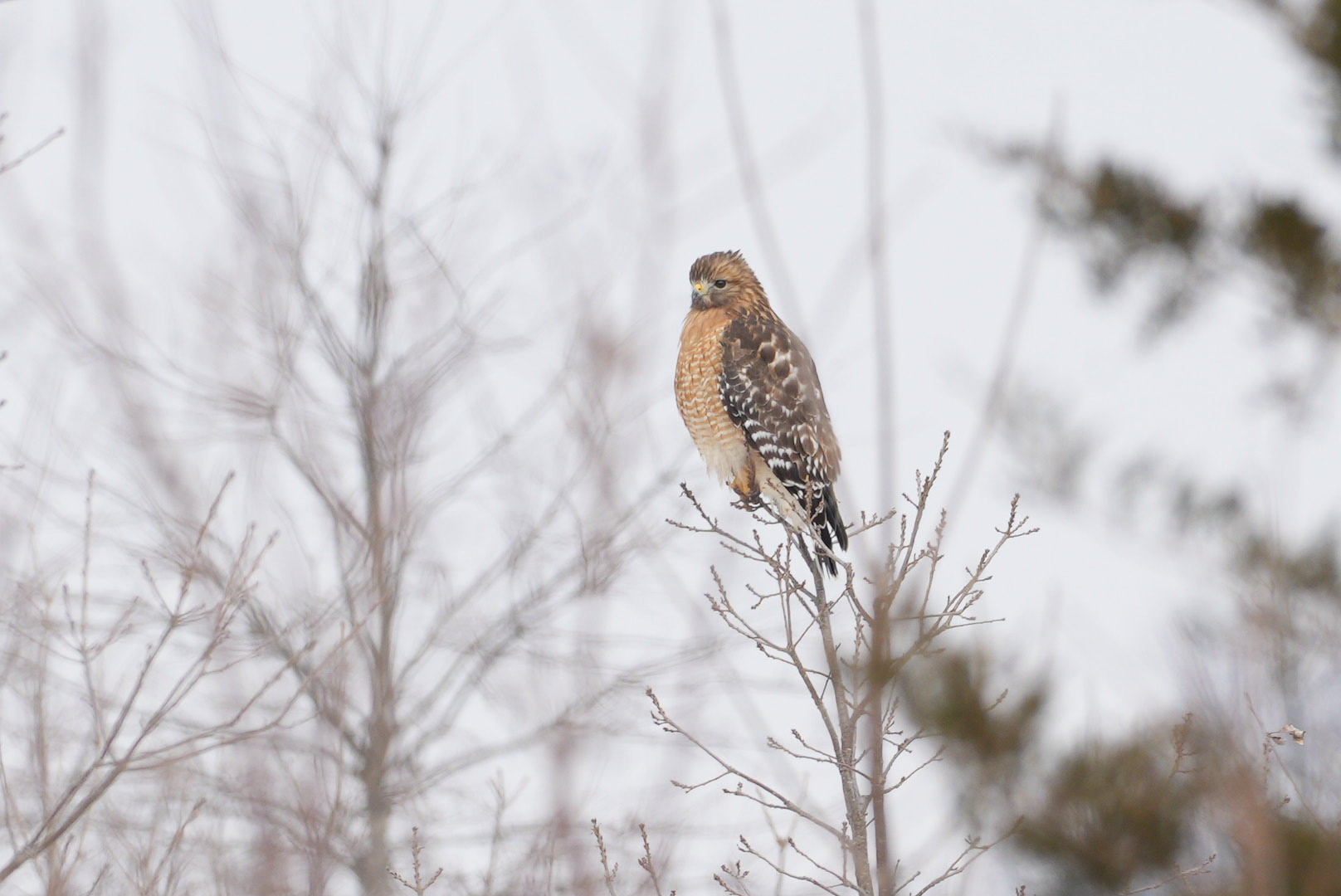
I have a little bit of time off at this time of year, and I attempted to drive out towards Harrow/Pleasant Valley which is always a nice, relaxing drive. Today, I did not see much while driving out in that area, but I did actually get a wonderful look at at  nice Red-Shouldered Hawk perched 15 meters from the road. Around the hawk was also a small flock of Eastern Bluebirds which was nice to see.

I was in Essex and had a notification that a Boreal Chickadee was found earlier this morning - and I figured I would try my luck in going to see it. This bird is not a lifer for me as I have seen some in Banff Alberta, as well as Algonquin Park here in Ontario. Luckily there were some birdwatchers there already when I had arrived and not long after getting there, two friendly birds, Kit M and Paul G called me over to see the bird. Boreal Chickadees are notoriously shy and difficult to photograph - hence the diagnostic photo above. 


Usually at this time of year, I try to reflect on how my birding efforts were this past year --- and for the most part they have been good. 

I have really made an effort not to drive out too far, too often, opting to stay closer to home. My own backyard and back field behind my house offer some decent habitat to see migrants such as Blue-headed Vireo, Orange Crowned Warbler, Lincoln's Sparrow --- I simply need to spend time on my back porch looking for the birds!


Some Highlights for me this year are:

Bell's Vireo - Lifer (point pelee)
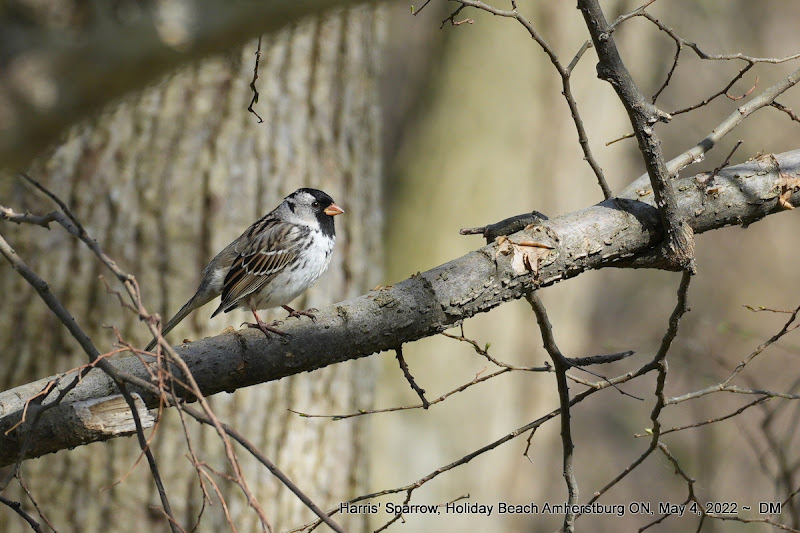
Harris's Sparrow - Lifer (Holiday Beach)
Kentucky Warbler (Point Pelee)
Tropical Kingbird (West Windsor)
Boreal Chickadee (Holiday Beach)
Blue Grosbeak (Illinois)
Henslow's Sparrow (Illinois)


Butterfly watching was not too eventful this year but I did see my first Harvester Butterfly at the Pinery.


So - its been a good year. I have slowed down a little but I'm still birding and getting out to enjoy nature.
Wishing you all a great new year for 2023!

Dwayne

Sunday, February 28, 2021

Northern Shrike, Red Shouldered Hawk + Bonus Astronomizing in February


Its really a beautiful time of year. The angle of the sun, the length of the day is slowly giving us a little taste of spring!  Red-winged blackbirds, Cardinals and House Sparrows have been singing their hearts out. Killdeer have returned to local fields - enlivening our soundscape. Turkey Vulture. I saw a Robin perched in a front-yard tree this week. I feel I have even seen a moth while night driving a few days ago.

Yesterday morning, I had heard that there was a Northern Shrike nearby and I made an effort to go see it. My sedentary lifestyle of sitting for most of the day is not doing any favours to my middle-aged body - so I take the effort to go for a walk on a nice weekend morning. The birds motivate me to get out there!

I had originally dipped on seeing the shrike (But I did see it later - *thanks Rick*) - but I did get a brief view of a Red-shouldered Hawk. Later I photographed a bird that I assumed was a red tailed hawk --- but after looking at it a little more ... I realized it might be a Juv Red Shouldered Hawk! (See collage  below). 


Here are three somewhat noteworthy astronomy sightings from the last week or so... Again --- I'm just starting out with Astronomy. All I am using is (https://stellarium-web.org/ ) stellariumweb app, my binoculars, my scope, and my Canon 7D 400mm Camera on a tripod.  In each of the three scenes below, I show the stellarium app view and the photograph I was able to take. 


Cancer (Crab Constellation)  - Beehive Star Cluster 


Triangulum Constellation - C28 - Starcluster 


Gemini Constellation - M35 Star Cluster in foot of Gemini


Good Birding, Good Astronomizing!

Dwayne 


Saturday, March 23, 2013

Birding in Fort Myers Florida (Part 2 of 2)


Red cockaded Woodpecker (pronounced caw-caided)

This second posting on my recent Florida Vacation birding highlights covers some of my newest lifers. One of the best birds I was able to observe was a single (endangered) Red cockaded Woodpecker (RCW) at the 80,000 acre Babcock Webb WMA [link][map]. Admittedly, there are two areas/colonies that biologists have placed artificial nestholes into the sides of large Long-key Pine trees to help these woodpeckers have easy/ideal nesting habitat.  Red cockaded Woodpeckers are endangered because their habitat is endangered. Large mature pine tree habitat, with prescibed burning-induced clearings to improve biodiversity.

On my third visit to the Babcock Webb WMA (my first visit was in March 2011), I had arrived at sunrise. While driving down the north end of Oilwell Grade road, I had seen a large raptor cross the road ahead of me. I stopped for a moment to see a Great-horned Owl perched on a pine limb. No RCW was found at the first RCW area, so myself and another pair of birders decided to join forces and move on to the other RCW area, which was on another road called Tram Grade road. Enroute to the second area, the other car took a wrong turn, so I stopped at the intersection of the two roads mentioned above and scanned three trees with white rings painted around their base to indicated that they have RCW nests. One of those three trees had a medium sized woodpecker with barring along its back and huge white cheek patches... RCW!!!

Perhaps the quick cellphone video I took in one of the other birder's scopes shows the woodpecker better than my photo. The video is not that great, as the other two ladies can be heard talking and taking photos. We were about 40 meters away from the bird and remained on the roadway while observing the bird. The bird flew eastward moments later and was not seen again.


Another highlight of my Southwest Florida birding was a morning walk at Corkscrew Swamp Sanctuary [http://corkscrew.audubon.org/]. This pristine 13,000 acre Audubon preserve is a breathtaking walk through several habitats, including the "largest remaining virgin bald cypress forest in the world (approximately 700 acres)" ... some of the trees had signs indicating they were over 400 years old!

Crappy photo of YCNH... A hard-fought lifer!
Two lifer species for me were the Yellow-crowned Night Heron and the Barred Owl. I found the YCNH to be a difficult bird to find for some reason. I don't think I would have found it without the help of a naturalist that was walking around. Luckily, it was dry season and only two small lakes remained, concentrating most of the birds to two smaller areas.

Barred Owl... Finally!

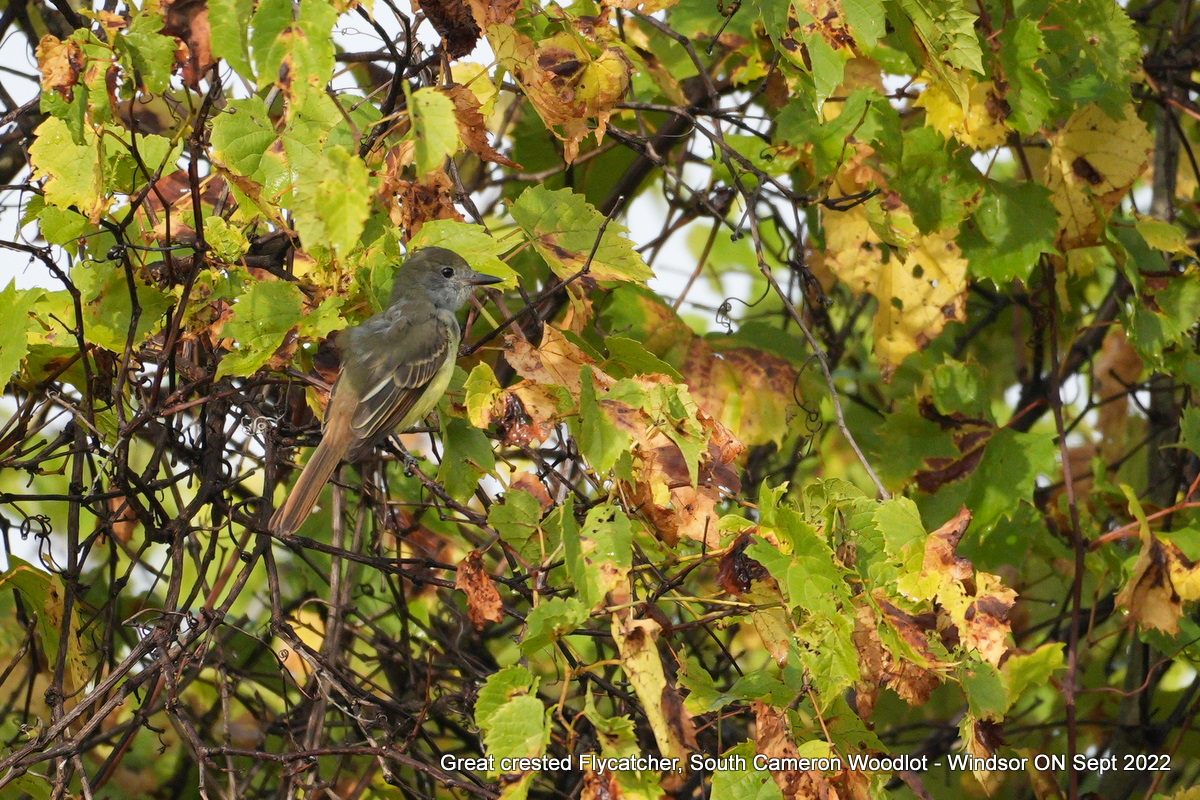
Other birds seen at Corkscrew Swamp were Indigo Bunting, Blue grey Gnatcatcher, Yellow rumped Warbler (lots of un-identified warblers at one point), Red shouldered Hawks, Pileated Woodpecker (heard), Yellow bellied Sapsucker, Roseate Spoonbill, Wood Stork, Swallow tailed Kites ( some overhead and circling in the distance). Near the parking lot, a calling bird near our picnic table turned out to be a White eyed vireo. The scrubby area near the parking lot was birdy and included Ruby crowned kinglets, Pine Warblers, Great Crested Flycather and more.


I found this bird while driving on a pretty major highway.  Pileated Woodpeckers were seen at  at Lover Key Park Beach, Corkscrew Swamp Sanctuary and this one while driving to Lehigh Acres.

Fish Crow: Cool to hear the different call this bird makes, especially after reading about Ontario birders hearing it near Fort Erie.  It's a softer "ka".

Poor photo taken in the mid-day sun. This bittern foraged in a thicket of reeds next to a walkway I was standing on.

This female Least Bittern was seen a Lakes Park, a nice municipal park in Fort Myers. I watched this bird forage for a while. At one point, I caught a minow and just held it in its beak for a minute before eating it. A Common Moorehen and Green Heron, as well as many Boat tailed Grackels were around. At one point, a Grackel started gesturing and pecking towards the Bittern. The Bittern pecked back and held its ground, but ... it just bugged me that the Grackel was being so aggressive towards it. Kinda felt bad, but both parties went back to foraging. It was incredible to watch this forage from 10 feet away. Not a lifer but still an amazing bird!

Good birding!
Dwaynejava

Lifer recap Since Dec 31st 2012:
Purple Sandpiper- Point Pelee #314
Glaucous Gull - Lighthouse Cove #315
Iceland Gull -Wheatley #316
White winged Dove - Rondeau #317
Swallowtailed Kite -SW Florida #318
Barred Owl-SW Florida #319
Yellow Crowned Night Heron -SW Florida #320
Red Cockaded Woodpecker SW Florida #321
American Oystercatcher - SW Florida #322
Burrowing Owl - SW Florida #323
Fish Crow -SW Florida #324
Eurasian Wigeon - Point Pelee#325

Fort Myers Birding Hotspots:


Corkscrew Swamp Sanctuary & Blair Audubon Center
375 Sanctuary Road West
Naples, FL 34120
Phone: 239-348-9151

SAN CARLOS BAY/BUNCHE BEACH PRESERVE

18201 John Morris Road Fort Myers, FL 33908


Babcock-Webb WMA
Charlotte County near Punta Gorda and Ft. Myers. From I-75, take exit 158 east 1/4 mile to the entrance;

Lovers Key State Park
8700 Estero Boulevard
Fort Myers Beach, Florida 33931
(239) 463-4588
Harns Marsh Preserve
38th Street West / Ruth Avenue North, Lehigh Acres, Florida, United States
This site, located in Lehigh Acres east of Ft Myers, has become known to birders as one of the most accessible places in Lee County to find Snail Kite, Limpkin, and other wading birds.  From 1-75, Exit 136, drive east on Colonial/Lee Blvd (CR 884) to Lehigh Acres.  Turn left on Sunshine Blvd and drive north past the Able Canal.  Just beyond the canal, the road curves and 31st St is on the left.  Turn left on 31st and make an immediate right on Ruth St.  Drive north on Ruth St to 38th St.  Turn left on 38th and drive west to the dirt parking area at the end of the road.  There are no restrooms at the site.
Reminders: Bring sunscreen, water, lunch/snacks and a scope.
Six Mile Cypress Slough Preserve
7791 Penzance Blvd, Fort Myers, FL 33966, United States

J. N. "Ding" Darling National Wildlife Refuge
Address: 1 Wildlife Dr, Sanibel, FL 33957, United States
 

Tuesday, October 23, 2012

Point Pelee Birding in Late October


A good birding friend mentioned to me this past Friday that Sturgeon Creek had incredible shorebirds so I figured I would try my luck on Sunday morning. It was gorgeous out, but my time at this pleasant pelee peninsula was brief.

Before entering the park, I stopped by the Hillman Bridge, which gave looks at Cormorants, Herons and Egrets but nothing too noteworthy. An Eastern Bluebird along with some yellow rumped warblers caught my eye at a residence near the marsh.


The promised shorebird show at Sturgeon Creek was decent, but difficult to take in with the eastern sunshine back-lighting the shorebirds. I did see a Sandhill Crane, as well as some Yellowlegs, Killdeer and groups of distant Plovers. Some Dunlin and one Semi-palmated plover were around but I left hoping to go back later during the afternoon sun.


Upon arrival to PPNP, I birded Delaurier trail. I did not see anything out of the ordinary. Lots of Juncos, Kinglets, Sparrows as would be expected. I think I may have even seen Pine Sisken but not too sure on that. I heard a Carolina Wren, but did not really see much. As I approached the Delaurier parking lot, I heard a bird singing its heart out, as I rounded the corner, I discovered that it was a female Purple Finch. It sounded like a red-eyed vireo!

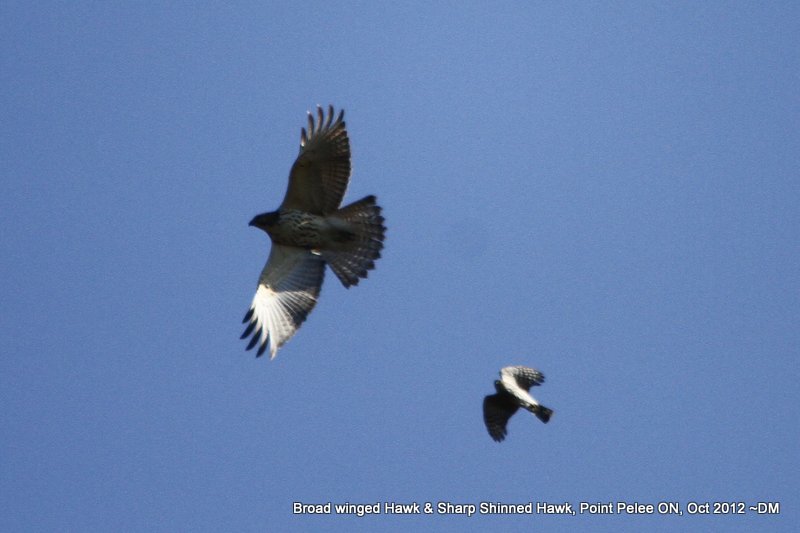
I was thinking while driving home about how a birder could easily set up a chair at the Delaurier Trail on the south side of the parking lot (looking north) and just watch raptors and huge flocks of migrating birds stream by overhead. Buteos and Accipiter Raptors were constantly streaming by! Huge flocks of Crows were in the Onion fields as well as flying overhead.
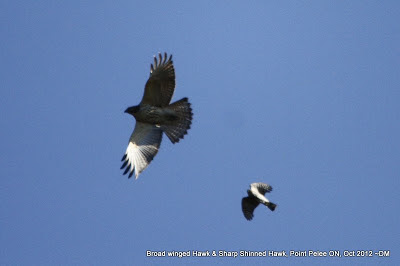
Broad winged Hawk being mobbed by a Sharp Shinned Hawk

Singing Purple Finch... very cool! I always see females, almost never males of this species.

 Shuster trail was my next and last destination on this short trip. All the seasonal birds that one might expect to see were seen. A nice treat though, was a Winter Wren. Overhead, more raptors were flying overhead, including this nice, low Red-shouldered Hawk.

'Shoulda

Winter Wren scolded me on Shuster Trail

East beach, at the terminus of Shuster Trail gave nice views of a pair of distant Bald Eagles. 

Back at Sturgeon Creek, I tried to scope out any shorebirds that were hopefully front-lit, but nothing too noteworthy. A few plover species.

The Saturday prior  to this trip(Oct 13th), I had birded Pelee with the Ojibway Birding Group and had a chance to see some cool birds. Off the top of my head some birds seen were:


Tip:
Vega Gull
Lesser Black backed Gull
Greater Black Backed Gull
Sanderling
Red breasted Nuthatch (many)
Blackpoll Warblers
Yellow rumped Warblers (many)
Golden & Ruby crowned Kinglets
Carolina Wren (heard)
Brown Creeper
Rafts of Scaup
Horned Grebes
Purple Finch
Northern Flicker (8 or so perched in trees near the tram loop)


Sparrow Field:
Hundreds of Chipping Sparrows
Lincolns' Sparrow
American Pipit
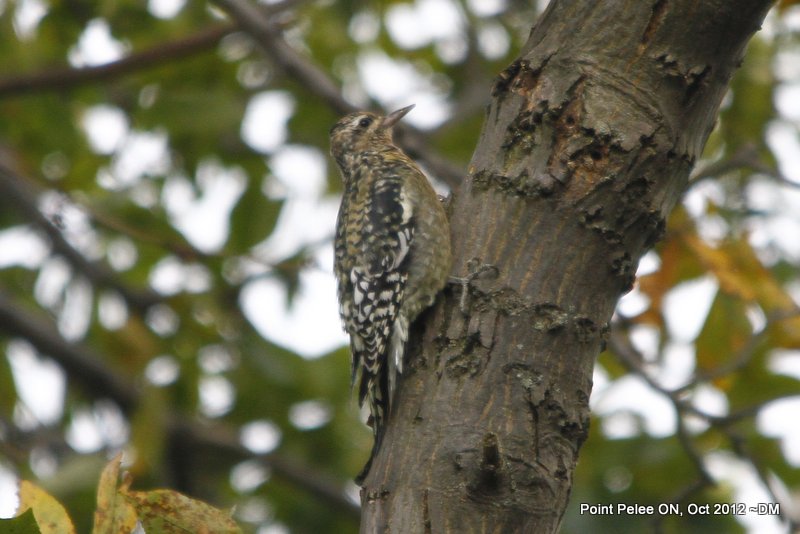
Yellow bellied Sapsucker
Overhead Raptors (Sharp shinned hawks, Coopers Hawk, Merlin)
Perched  Turkey Vulture
Palm Warbler
Indigo Bunting (seen by some)


Good Birding!
Dwaynejava


PS: The latin name for Winter Wren is "Troglodytes Hiemalis"... Troglodyte being a Greek word meaning "Cave Dweller". Hiemalis is latin for Winter. Winter Wrens live in the underbrush in damp, rotting wood thickets. I've had some luck finding them at Shuster Trail in the Spring and Fall, as well as Holiday Beach near the Hawk Watching Tower.

Winter Wren is one of three images that Cornell University's Allaboutbirds.org website is using of mine.

It can be seen at this link:
http://www.allaboutbirds.org/guide/Winter_Wren/id

Other images they are using include: Golden Eagle, Yellow bellied Sapsucker

I couldn't help but try to recall where I heard the word "troglodytes" before, and I recalled reading the word this summer and not really knowing what it meant. I found the cartoon I had read a while back using a quick google search. It was from a political cartoon in Windsor. So go ahead and incorporate the word "troglodyte" to your vocabulary!


Image Source:
http://blogs.windsorstar.com/2012/06/23/mike-grastons-cartoon-for-june-23-2012/


LinkWithin

Related Posts Plugin for WordPress, Blogger...