Showing posts with label Prairie Warbler. Show all posts

Saturday, March 16, 2024

Birding Miami Florida in March 2024


I spent the last week in the Miami/Fort Lauderdale area. The trip was with my wife and two boys and was for generic leisure and birding was not the main priority. Even still I made great efforts to visit a few natural areas over the week and get some birdwatching and butterfly watching in. In almost an underwhelming fashion, I was able to pick up one life bird and one life butterfly.


Target birds that were possible but not likely-
Mangrove cuckoo(migrates in late march)
Western spindalis
La Sagra's flycatcher
Thick billed vireo
Black wiskered vireo
Local parakeets
Least tern (migrates in late march)
Short tailed hawk

Miami Blue butterfly - extinct to extirpated to a few small islands near key west. Read more here: Miami Blue Butterfly | FWC (myfwc.com)


My efforts to birdwatch was to look at some hotspots in ebird and focus on some of the top locations.


Bill Baggs Park -Key Biscayne (link)
Prairie Warbler
Chuck wills Widow
Common warblers
Little blue Heron
Sanderling
Magnificent frigatebird
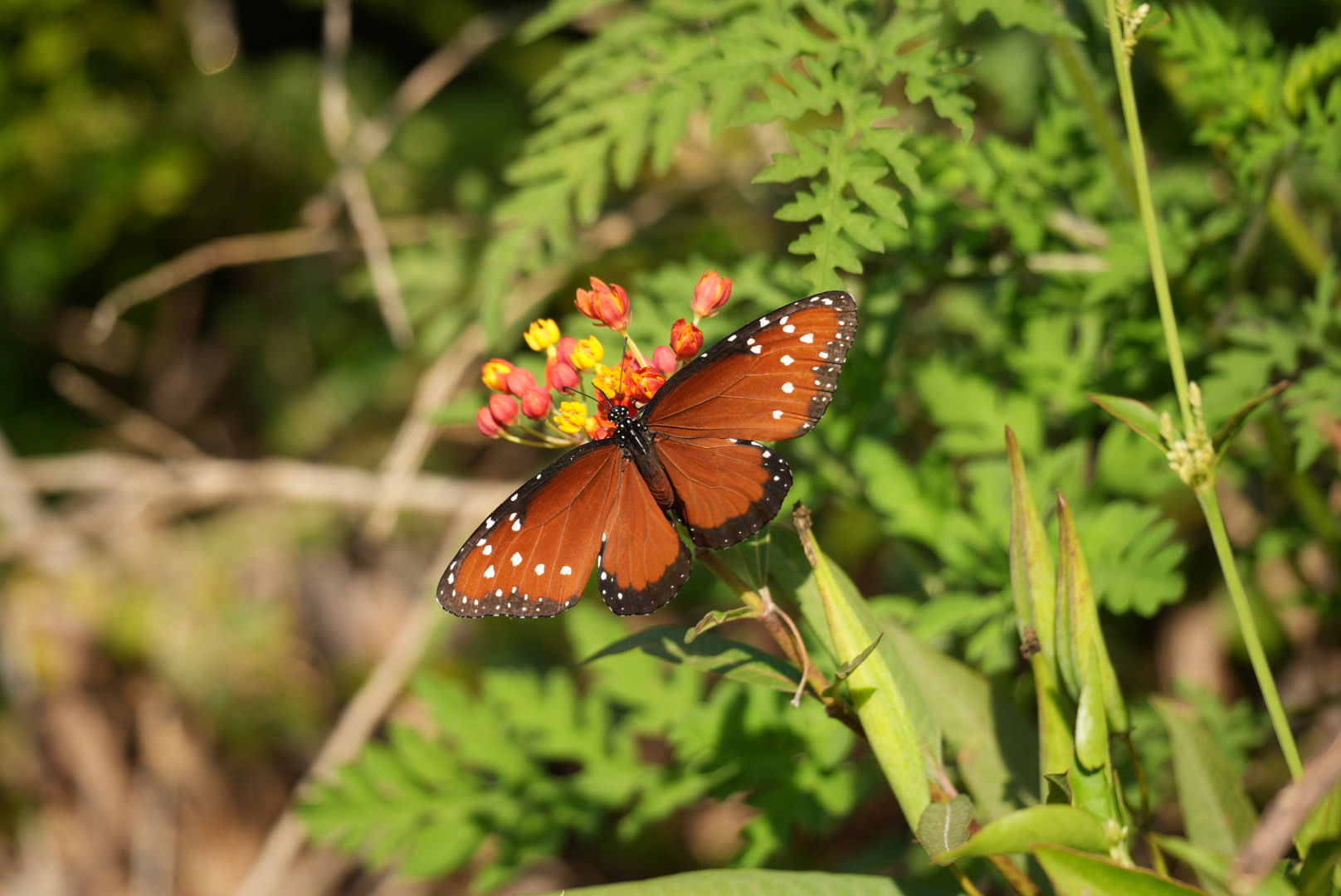
Queen butterfly
Julia butterfly



Chuck Wills Widow ! (seen flycatching in leaf litter in mid-morning, then perched)


Anne Kolbe reserve - Hollywood Fl (link)
Yellow throated warbler
Yellow rumped warbler
Palm warbler
Black and white warbler
American redstart
Northern Parula
*Mangrove tree crab


MATHESON HAMMOCK PARK (link)
Yellow throated Vireo
Red shouldered hawk
Red headed woodpecker
Yellow rumped warbler
Palm warbler
Red shouldered hawk
Magrove skipper (worn - but life butterfly)
Zebra longwing butterfly


Mangrove Skipper (worn) - Life Butterfly (#164)


Random neighborhood baseball diamond
-Loggerhead shrike
-Prairie Warbler


Hal Scott Preserve (link) (closer to Orlando ---  Red cockaded woodpeckers are here but i did not see them on this brief visit.  )
Eastern bluebird
Brown headed nutchatch
Blue grey gnatchcher
Bachmans Sparrow (lifer! #471)
Pine warbler


Bachman's Sparrow - Lifer. Most certainly soon to be renamed


I guess this trip has reminded me that even if ebird shows that a bird may be present in a location.... 90% of the days you might only see the (at best) 90 percentile birds. An area that seems promising can be a let-down and seemingly devoid of birdlife, but another area that seems to not be of great significance could have surprisingly good birds. Sometimes we have to remember that the best part of travelling is the journey, not the destination itself. 

Good Birding,
Dwayne

Last Few Life Birds:
Black crested Titmouse (TX) 466
Snowy Plover (TX) 467 
Neotropical Cormorant (TX) 468
White tailed Kite (TX) 469
Least Grebe (TX) 470

Bachmans Sparrow (FL) 471


Last few Life Butterflies:
162 - Southern Dogface (Zerene cesonia) - Caves San Antonio TX , yes [link] 
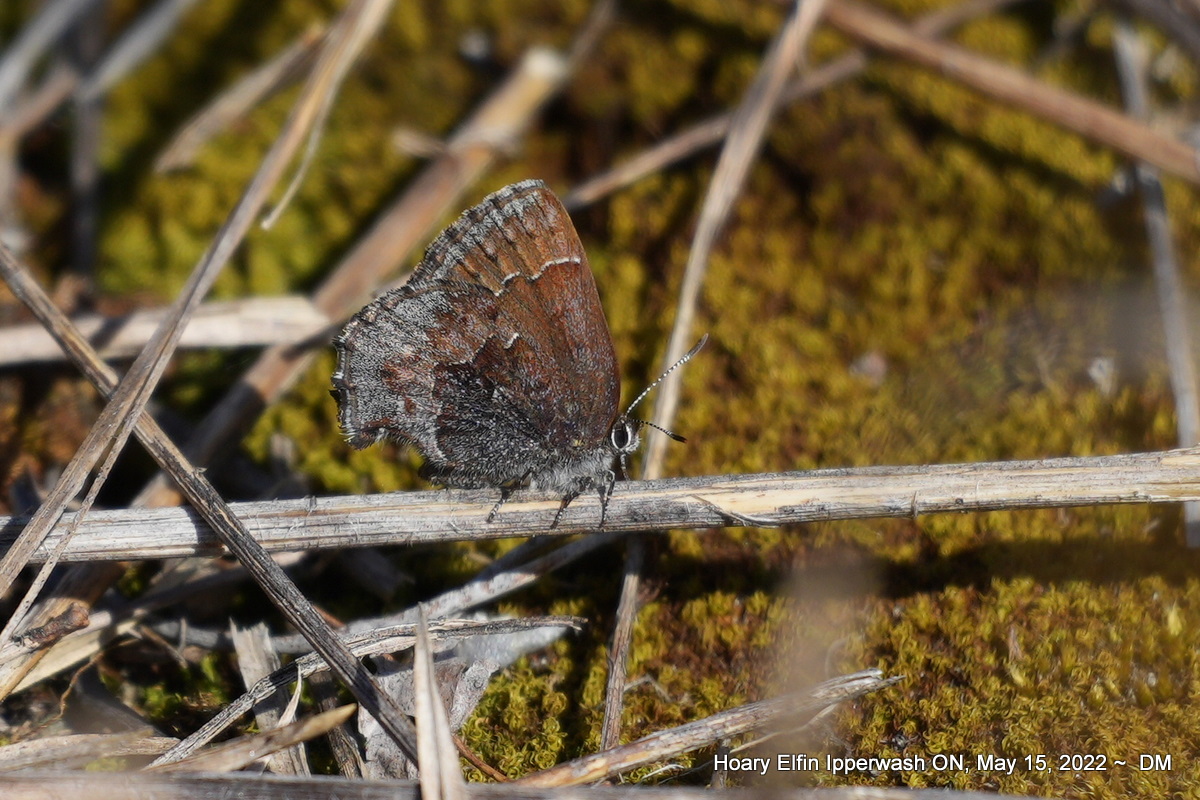
163 - Henry's Elfin (Callophrys henrici) - Caves San Antonio TX , yes [link] 

164- Mangrove Skipper (Phocides pigmalion) - Mattheson Park Area MIAMI FLORIDA, yes [link]

Tuesday, July 26, 2022

Bell's Vireo and Mid-May Pinery Butterfly Watching (2 butterfly lifers?)


(*editors note: This is a blog posting from the middle of May 2022 - I have not posted it until late July 2022)

I took a personal day from work recently - and headed out to Point Pelee for some early May birding. I randomly chose May 12 as a day to go in the second week of May. I spent much of my time on West Beach - looking for Kirtlands Warbler - and had many great birds that I had not seen in some time. Northern Mockingbird, Black Billed Cuckoo, tonnes of Thrushes and Ruby throated Hummingbirds were present on that particular afternoon. But, Bells Vireo was the highlight, and through the power of whatapp - I was able to see this great bird found by "the dutch crew" & Steve Pike. I must have seen 10-15 hummingbirds on this particular day, and it was nice to see one actually do it mating / territory flight right in front of me along the west side foot-path.  Occasionally while photographing these beautiful birds, I would get reflective flashes of "ruby" from the gorget feathers on the birds throat. These colours that we see as birders are unique in that although there are various inks and computer monitor colours made from three primary colours mixing --- I think some of the colours we observe as naturalists can only be seen and fully appreciated in the field. In summary, the colour of red from a Scarlet Tanager, or an indigo bunting is best appreciated IRL (in real life).

Bells Vireo


Clay Coloured Sparrow @ Black Oak Herritage Park in Windsor


Pinery May 15th - Butterfly watching during peak birding season?

I found myself supervising/coaching a tennis tournament that had me in Sarnia on Sat May 14th. Instead of driving home after the tournament, I had booked a hotel to stay the evening and spent the following day at the Pinery. I was with my family, but I attempted to butterfly watch and bird as much as I could. Some May specialties were found, Olympia Marble, Frosted Elfin, American Lady, Dreamy Duskywing. ... I was looking for Mottled Duskywings and instead found a Harvester butterfly - which is famous for having a carnivorous caterpillar. It turns out that an Azure species I had seen on this date is a second life butterfly - According to R. Cavasin (* Northern Spring Azure (C. lucia) ) . Inaturalist is a wonderful tool for us nature lovers! See this link for that sighting: https://inaturalist.ca/observations/117214978 . These two new species are my 159th, and 160th butterfly species. 

Birding was great, with Prairie Warbler heard almost as soon as I entered the lakeside dune habitat that they often frequent. RH Woodpecker, BB Cuckoo, Pine Warbler as well as several empid species were seen. 


Lifer Summary - Last ~10 BIRD species:

Western Screech Owl 453 (AZ)
Scaled Quail 454  (AZ)
Graces Warbler 455  (AZ)
Painted Redstart 456  (AZ)
Yellow Eyed Junco 457  (AZ)
Blue throated Hummingbird 458 (AZ)
Elegant Trogon 459 (AZ)
King Rail 460
Red Phalarope 461
Scissor tailed Flycatcher 462
Hoary Redpoll  463
Cave Swallow 464
Harris' Sparrow 465
Bell's Vireo 466


My last 7 Butterfly Species: 
154 - BOG COPPER  ( Lycaena epixanthe ) - London ON , yes [link]
155 - Compton Tortoiseshell (Nymphalis vaualbum) - Newbury ON - yes [link]
156 - Short Tailed Swallowtail( Papilio brevicauda ) - Kouchibouguac National Park , yes [link]
157 - Maritime Ringlet( Coenonympha nipisiquit ) - St Andrews NB [link]
158 - Green Comma (  Polygonia faunus) - Fredricton NB, yes [link]
159 - Harvester ( Feniseca tarquinius ) - Pinery Provincial Park , yes [link]  
160 - Northern Azure (Celastrina lucia) - Pinery Provincial Park , yes [link] 

Sunday, May 16, 2021

Mid May Migrants - Recent Highlights + Bonus Astronomy Photo (Bode's Galaxy)


Over the last two weekends I tried to do a little birding - it is mid May after all - and migration is in peak swing. I have tried to bird a little closer to home this year - although --- I have made short trips to Holiday Beach, Rondeau and Pelee. 

I think the consensus is that things have been very slow this year. I keep thinking about an older birder who told me that many years ago, it was not uncommon to walk down Shuster Trail to the Tildens' Woods Pathway at Point Pelee and have 30+ species of birds. 

There is also the idea that migration happens in 3 waves - one around May 4-7, one around May 15th, and perhaps one last one around May 20th and outside of those three waves, migration trickles through.


A weekend trip to Rondeau last weekend resulted in seeing a Prairie Warbler found by Blake Mann. While the park was a little quiet that day, I did manage to find a few pockets of warblers and had some great looks at Northern Parulas and Magnolia Warblers --- which are both stunningly beautiful warblers.


Yesterday - May 15th, I went to Holiday Beach and had a pretty nice walk. I was amazed to see several Scarlet Tanagers - perhaps as many as 6, along with Prothonotary Warblers, Bay breasted Warblers, Philadelphia Vireo and Red Headed Woodpeckers to name a few. Of course, one birder that I was talking to mentioned that Friday the 14th with much better... Of course.


Today I headed towards Hillman Marsh and Pelee. One of my goals was to find a Neotropic Cormorant (which I have still not lifered) - but try as I might - I just could not pick it out from the large group of Double Crested Cormorants. Hillman Marsh shorebirds were sparse - I mainly noted Dunlin, SP Plovers and a pair of Sandhill Cranes. Kopegaron Woods was nice. A few pockets of warblers near the parking lot amuzed me for a while. Some birds included Scarlet Tanager, Indigo Bunting, Bay Breasted, Blackbirnan, Magnolia, Black and White, and a brief look at what was perhaps a Hooded or Wilsons Warbler. 

A brief walk between Delarier and Cactus Field at Pelee was nice but a little quiet. I did see a few small pockets of warblers - including Northern Waterthrush, Black throated Blue, Black throated Green , Parulas, Chestnut sided, A highlight was a Blackpoll Warbler. A few Least Flycatchers were calling with their "chebeek" call. 


I am looking forward to the "third wave" warblers and migrants in the next week or so to kick off the migration season for 2021.  Some birds I hope to see include Canada Warblers, Connecticut as well as some later shorebirds such as Whimbrel, Red Knots and White rumped Sanpipers maybe?

Good birding!

Bonus Astronomy Note:
I went out on May 14th late at night to do some stargazing. I had heard about this pair of Galaxies that are visible in the constellation Ursa Major (big dipper). M81 and M82 are both pretty easily photographed if you have a tripod, 400mm lens and a star-map app (stellarium).  This photo below shows M81 (Bode's Galaxy) and M82 (Cigar Galaxy).  Bodes Galaxy is 12 million light years away. That means the photons my camera collected have travelled for 12 million years to make it to earth. Also --- here is another cool thought... Every single star that you can see in the sky is in our home Galaxy, the Milky Way. Our galaxy has 100 thousand million stars --- ( 100 Billion stars?) ... So that dim fuzzy ball of light you see below is not a star in our galaxy... its its own galaxy, 12 million light years away, hosting hundreds of billions of its own stars. I am proud to be a budding astronomer and that I have the ability and the basic equipment to make such observations!


LinkWithin

Related Posts Plugin for WordPress, Blogger...