Showing posts with label New England Aster. Show all posts

Sunday, October 3, 2021

Willowleaf Aster and other Late Bloomers * Late Summer Botany *


Living close to Ojibway Park in Windsor - I have really made an effort to find many of the rare plants that make Ojibway such a unique place in Southwestern Ontario. My latest find - Willowleaf Aster is somthing that I have wanted to see over the last few years, but since there are many types of Asters, the identification process is a little bit challenging!

I thought I had found this species last year, and I had posted my sighting on Inaturalist - but some botany experts suggested I had mis-identified the species based on the leaves along the stem. But this year, I think I have finally found a few patches in Windsor that I can confidently say that I have the proper ID. The flowers of this plant are a very light purple colour (almost white) and the colour can be made a little more apparent by underexposing the photos when photographing the plant. Allan W. from the NatureNuggets blog who is an excellent source of information gave me some tips on field marks to look for, such as the patterns on the underside of the leaves on this species. The subtle impression I get when I look at this plant is that its an Aster plant that have "rosemary-like" leafy stems throughout. They get willow-like as you move down the stem towards the ground.  


I almost goes without saying that the beautiful autumn flower show that is provided by Goldenrods and Asters makes the change of season (with its shorter days and colder temps) a little more bearable. 

Some other plants that are fun to find at this time of year are Fringed Gentian and Bottle Gentian flowers, that are found in some prarie habitats within the Ojbiway Park network. Fringed Gentian is not a perenial, so I find that looking for them each year requires a little bit of walking around in good habitat and they seem to show up in new places year after year. 


Backtracking a little to summer, I had found a pretty rare plant at Ojibway which is Whorled Milkweed! I was blown away to find this and I can't help but wonder if its naturally occurring or if it was planted?


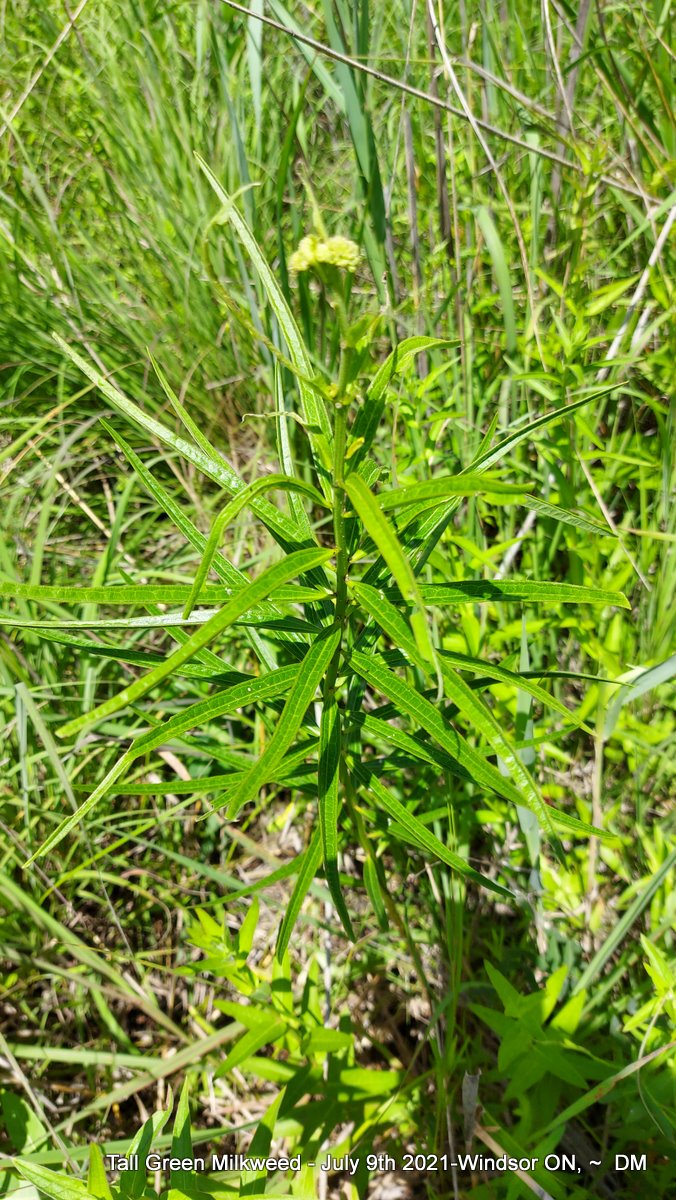
Speaking of rare milkweed plants, I had observed a single specimen of Tall Green Milkweed this summer as well (around early-mid July).  I had gone back a few weeks later to see this plant in full flower, but sadly, its flowers or the top of the plant had been gnarled somehow, perhaps deer herbavory?
Anyway - I have been a little busy with work/life but I still value the chance I have to blog some of my nature sightings. I think writing really lets a person think, reflect, share ... put ideas down into words. Perhaps create memories or give someone else a chance to see what I'm seeing in my little corner of the world. I really think botany is a great hobby, and I've enjoyed learning from the blogosphere of Naturalists that I follow. 

Good Naturalizing!

Dwayne

Sunday, September 18, 2016

September Yard Birding


Just a short posting for tonight. Yesterday (Saturday) it rained for the first half of the day. I wanted to get out and enjoy some nature but it was simply a washout! So I sat on my back porch and just enjoyed a coffee with binoculars in hand. To my amazement, a large redish bird perched in some shrubs in my backyard --- Brown Thrasher! Then, perhaps 20 mins later - Swainson's Thrush! Three warbler species were present - Palm Warbler, Nashville and Tennessee! Song Sparrows were singing - oddly-- then a new yard bird --- a first year Scarlet Tanager! A little later - two Eastern Pewees.  I'm amazed that even on a crappy, rainy day --- that the birding is that good in my back yard.


This morning - similar birds. I had less time to be outside - but another Scarlet Tanager showed up - to my amazement!


This afternoon, I went to Pelee to followup on a recent butterfly posting to the Ontario Butterflies Google Group. One report stated lots of southern butterflies are present around Pelee - including Little Sulfur, Grey Hairstreak, and lots of Fiery Skippers. I only walked west beach to sparrow field - but I did see two Grey Hairstreaks and a single fiery skipper among other more common butterflies. A field near the PPNP Admin building had many more fiery skippers to look at. Some posed nicely on New England Aster.


Good birding, butterfly watching and nature lovin'
Dwayne

Wednesday, October 1, 2014

ROM Butterflies of Ontario Field Guide Review plus Bonus Video: Vlogging Entimologists!


I recently ordered a copy of the ROM Butterflies of Ontario field guide online and obtained my copy today. I was a little reluctant to get a ROM guide after being a little disappointed with the ROM Birds of Ontario field Guide. The problem with the ROM birding guide was that only one image of each bird was provided, and that was a shortcoming of that book because birds can have many plumages due to age, time of the year and of course, sexual dimorphism.  My initial impression of this book though has been much better. The photography is excellent. The writeups are good and cover lots of information. The range maps are nice - customized to the province of Ontario and even include specific points that the particular butterfly has been found in. Data perhaps garnered from E-butterfly databases and other historic records.


The first section of the book is excellent and includes the following:
  • History of Butterfly study in Ontario
  • Butterfly morphology
  • Factors influencing butterfly distribution in Ontario
  • Conservation and protection of Ontario butterflies
  • Where to Observe Butterflies (including nice profiles of the top 14 butterfly watching sites)
  • Observing butterflies  and documenting records
  • Butterfly Gardening
The image below shows the first of 14 butterfly hotspots spread out throughout the province. It was great to read about Ojibway Prairie as one of the main featured areas for butterfly watching.  The next page features Point Pelee. Two hotspots in Essex County. Exciting!  I plan on making trips out to all these corners of Ontario during upcoming summers.

Each butterfly basically has a two page spread that includes great photography of both the dorsal and ventral view of the butterfly, as well as the larval form (Caterpillar). Occasionally, a host plant images is included as well. Range maps and distribution details are excellent.

I was wondering if some extirpated species were included in this book, and it seems yes, they are. I think field guides and other books relating to natural history should include extinct and extirpated species, just to remind us of what should be here and to remind us that we need to increase conservation efforts.


Well, here is the promised video. Its not really a Vlog (Vlog is short for Video Log or Video Blog), but rather, a recorded webcast... But I just thought it would be cool to say: "Vlogging Entimologists"! Its interesting to watch these two ROM authors just sit around and talk about butterflies in Ontario. Its nice to see the authors behind the books you are reading. Enjoy!


One might be curious to know how this guide compares with the recent and excellent Kaufman butterfly guide? I think they are both great, but the ROM guide simply focuses on the Ontario species whereas the Kaufman guide tackles a much larger area: All of the US and Canada! Its a matter of depth versus breadth. So, since so much breadth is covered in the Kaufman guide, there is not much depth. The ROM guide provides much more depth, but less breadth. Both are excellent.


There was some interesting discussion about this field guide on the Ontario butterflies google group. There were some criticisms about inaccuracies in the book or mistakes... perhaps made by inaccurate data entry or mistaken observations.  The debates were interesting, and at times somewhat heated... But rest assured it remained civil :-) One butterfly enthusiast made a comment that... (I forget the context of his discussion - perhaps regarding the data discrepencies and the volunteer efforts to fix them) but he mentioned that we are all paid in "butterfly bucks"... Too funny.

I plan on reading this book and just leaving it on my coffee table for my kids to flip through. I recommend getting it!


Good Birding & Butterfly watching!
Dwaynejava

At the time of publishing, this book is 37% off the cover price at Chapters/Indigo. See link below.
http://www.chapters.indigo.ca/books/the-rom-field-guide-to/9780888544971-item.html


Sunday, September 16, 2012

Hawkfest Birding at Holiday Beach & Pelee


Saturday morning, the family and I headed out to the hawk festival at Holiday Beach.  A few Kestrels flew overhead as we arrived and some kettles of Turkey Vultures and Broad wings (at stratospheric levels) were seen. The Canadian Peregrine Foundation had some captive raptors on display including this Barn Owl above. I find it kinda sad to see any captive bird and was almost reluctant to post this gorgeous bird (he looks so sad!). This weekend was not too great for Hawkwatching. The winds were southerly and little was moving. I guess on Tuesday this week, a huge cold front will push lots of raptors south.

While leaving Holiday Beach, I walked along the scrubby area parallel to the beach with my son and saw a few warblers: Blackpoll, Blackburnian and Nashville Warblers were seen briefly. Nuthatches were heard but not seen. A few flycatchers were around but I did not really have time to really ID them. I think one was an Eastern Pewee, and the other (see below) may be another Olive sided?!?

Audubon Magazine recently had an article which listed out the ten best Hawk-watching places in North America, and Holiday Beach was third in the list!  Pretty cool. See the article here: http://www.audubonmagazine.org/articles/birds/audubon-guide-hawk-watching

Another Olive sided Flycatcher?
Blackburnian Warbler... Non Cooperative...

Sachem on New England Aster Behind Pelee Inn
Point Pelee Tour with the Family 

A large tree in Sparrow Field always has Hackberry butterflies on it. It may be leaking sap.

Point Pelee was quiet bird-wise until my wife and two sons visited the tip. While leaving the beach and getting onto the west path back to the tram loop, I noticed many birds in the first few trees at the tip of Point Pelee. The trees were crawling with Red-breasted Nuthatches (10+?), Yellow rumped Warblers (6) and Blue grey Gnatcatchers (4).  A single southernmost-Sanderling was trying to avoid tourists walking the beach at the tip of Pelee... the only shorebird. Hundreds of gulls  (some black-backed) and Cormorants were on the three islands that extended out from the tip of Pelee.


Checkered Skipper on Short's Aster

Good birding,
Dwaynejava


PS: A little buzz in Windsor lately about a birding film being shot at various parts of Essex including Ojibway Park.

http://www.youtube.com/watch?v=FQ2cWzqjnaA&feature=related
http://www.windsorstar.com/entertainment/Cavanagh+soaring+Birder/7246574/story.html
http://www.ctvwindsor.ca/tag/the-birder/

Praying Mantis. On my son's play-house!

LinkWithin

Related Posts Plugin for WordPress, Blogger...