Showing posts with label Wild Indigo Duskywing. Show all posts

Sunday, September 27, 2015

Grey Hairstreak and other Recent September Migrants

Grey Hairstreak at Point Pelee

[Editor's Note: This posting is a hodge-podge mix of like three separate nature viewing hikes. My last posting about Fringed Gentian Wildflowers merited its own post so this one covers the last two weekends.. Thanks... ]

Seeing this Grey Hairstreak last weekend was a nice recent nature viewing highlight.There are years when I don't see this so it is somewhat rare in my opinion.  Shortly after seeing it, I was informed that a Funereal Duskywing was seen at the tip of Point Pelee --- but the small group of butterfly enthusiasts that I was with could not re-find it. The Duskywing and Crescent species below are sometimes confusing to identify but the time of year helps with their identification. 


Over the month of September, I've had amazing birding in my back yard.  Palm, Nashville, have been the most common, but Common Yellowthroats, American Redstart, Wilsons have been seen in lesser numbers.


Today at Pelee, I walked around with the family, and noted few birds.  At one point, Blue Jays were going crazy near the tip, and looking up, it would easy to see 5 sharp shinned hawks and even a Peregrine Falcon! A few Sanderlings and a group of about 10 Surf Scoters flew by in the short time I was at the tip.


Last weekend, I joined Jeremy Bensette for an OFO guided hike at  Point Pelee. It was pretty birdy and one of my personal highlights was Grey Checked Thrush, Winter Wren and a nice assortment of Warblers. A perched Carolina Saddlebags dragonfly was a nice find.
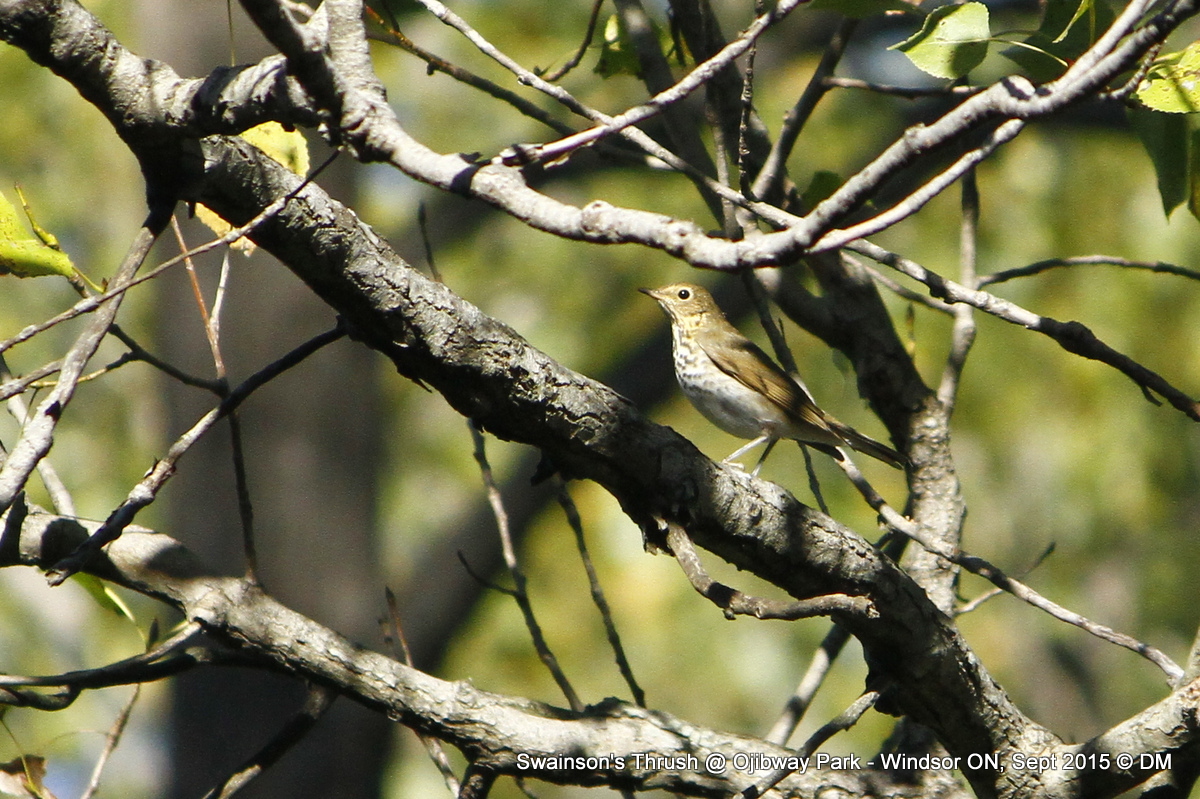


Hermit or Grey Cheeked?


I've seen many thrush species in the month, but have questioned myself ... I think I'm seeing Swainson's Thrush and Grey Cheeked... but what about Hermit Thrushes?

Good birding!
Dwayne
Tall Boneset? It was over 5' tall. Growing in the sandy soils of Black Oak Heritage Park.


Sarah R in the news

VW Accused of fooling emissions tests with software

2015 On Pace to being the hottest year in the last 140 years

Asian Carp found in Lake Erie:

Tuesday, July 21, 2015

A Walk Through Canard Valley Conservation Area


I stopped by Canard Valley (CA) Conservation Area today on the way to going to Colasantis with my son. It is not a well known area and it not well marked. You have to really want to go there to find the place! Anyway, I only walked along the Canard Valley (Creek) for about 100 or so meters but it was very nice! It just felt special to walk down to the water level of this waterway and to stand on its floodplain and realize that this is a tiny remnant of our region's natural history. This conservation area is known for one of Canada's best population of Kentucky Coffee Trees, a rare hybrid of Trout Lily among other things. This site is even mentioned in a fantastic publication by the EPA about the Lake St Clair/Huron/Erie Ecosystem [link].

Upon getting out of my car I noted a Banded and Striped Hairstreak as well as some unidentified skippers. Lots of Summer Azures were present as well.


I noticed many Dun Skippers nectaring on a perennial that I've been seeing a lot lately - Heal-all. Heal all is an edible plant! It also has beautiful petals. 

My best observation though was a nice Dukes Skipper! The first one I had seen was very obliging and I captured both dorsal and ventral views of the fluttery beast. I noted a second Dukes a moment later but I only had a chance to photograph the dorsal markings that distinguish it from a female. The male has the black line (stigma) though the orange patch on its upper forewing. Below, I've featured a Dukes Skipper image that features dorsal and ventral composite views, showing both the male and female sexual dimorphism of this species. 

Dukes Skipper - Dorsal and Ventral Composite
Other pics from this week:


This female Black Dash looks very similar to a Mulberry Winged Skipper that I have been looking for.

Good Birding!
Dwayne

Further Reading:


Brilliant Atlas of the Lake Huron/St Clair /Erie Ecosystem
http://www.epa.gov/ecopage/stclairbiodiv/stclairbiodiv.pdf

Map of Natural Areas in Essex County
http://wecec.org/pdf/publications/Natural_Areas_Map.pdf

Canard Valley Land Donation in the News
http://rivertowntimes.com/canard-valley-conservation-area-grows-thanks-to-public-private-partnership/

Kentucky Coffee Tree in Canada
http://www.sararegistry.gc.ca/virtual_sara/files/plans/rs_kentucky_coffee_tree_e_final.pdf

Dukes Skipper
http://www.cbif.gc.ca/eng/species-bank/butterflies-of-canada/dukes-skipper/?id=1370403265601

Heal All Plant
https://en.wikipedia.org/wiki/Prunella_vulgaris

Where are the Monarchs? Summer 2015
http://www.cbc.ca/player/News/Canada/Windsor/ID/2672318991/

Thursday, July 11, 2013

Duke's Skipper and an unlikely Little Sulphur (Eurema lisa) -v2


Dukes Skipper on Chicory


I stopped by Brunet Park in LaSalle this morning, and to my amazement, photographed a skipper species that I had never seen, but recognized. This skipper had a long streak (or ray) on the underside of its hindwing that hinted of Duke's Skipper. Duke's Skipper and Dion's are quite similar, but the forest-edge habitat that Dukes frequents hinted that I had a pretty rare butterfly on my hands! Thankfully, I emailed the experts to get confirmation. Alan Wormington and Blake Mann confirmed the identification for me. 

More on Dukes Skippers:

Another rarity (in my opinion anyway) was a "Little Yellow" I saw at Point Pelee yesterday. I saw it for just 5 seconds... I obtained this crappy but diagnostic photo.  Very cool! Just to get a sense of how rare these two are, neither of them were on the Ojibway Butterfly Count tally results [Link]... So pretty rare butterflies! 

I've never seen a Little Yellow in Canada. I had seen some along the road during my last trip to Florida, but was unable to get out and really look at them (I was stopped at an intersection). 


Hickory Hairstreak - Another Brunet Park Gem


Back to some more common butterflies...


Good butterfly watching!
Dwayne

Sunday, August 19, 2012

Red necked Phalarope at Point Pelee's Lake Pond


With numerous Ontbirds postings over the last week about Red necked Phalaropes I figured I would make an attempt (my last for the season) to kayak Point Pelee's Marsh (Lake Pond) and find them myself. Sure enough, a pair was spotted at one of the first "Islands" that I visited. The black streak across the eye is easily seen from great distance! One of the two Phalaropes had some golden highlights in its plumage, and the other was monochromatic.


Like I've said many time before, it seems shorebirds ignore people when they are in a kayak. I was about 5 meters away from these two Phalaropes, a Greater Yellowlegs and a few Semi-Sandpipers. At one point, they flushed because of a Northern Harrier that flew by, but then returned immediately.

Some birds that I saw today (Saturday) include:

Red necked Phalarope  2
Short billed Dowitchers 20
Black bellied Plovers 3
Least Sandpipers 30
Semipalmated Sandpipers 30
Yellowlegs Sp. 6
Semipalmated Plovers 5
Spotted Sandpiper 5
Killdeer 10

Perhaps more diversity could have been found by navigating to other areas of Point Pelee's Marsh (see map), such as West and East Cranberry Pond, but as usual, I only had a few precious hours to bird on Saturday.
I was hoping this was a Western Sandpiper, but no, its Semipalmated.
Yellow legs
Butterfly Watching
 
A ditch on the nortwest side of the road leading to Point Pelee had about 20 meters of Purple Loostrife and many butterflies had taken notice. Whites, Sulphurs, Painted Lady, Monarch, Common Buckeye, Grey Hairstreak, Fiery and Sachem Skippers were all present. 

Earlier on in the week, I had photographed this Duskywing below. I had heard about some duskywings having a plume on their hindlegs, so I thought I had found something interesting here.  An online book I found while researching (Butterflies of Canada) mentioned that the following duskywings have such plumes: "Male duskywings of Icelus (Dreamy Duskywing - Too late in the season), zarucco, Funeralis, Persius (Persius Duskywing), Lucilius (Columbine), Afranius (Afranius Duskywing), and Baptisiae (Wild Indigo) have hair plumes on their hindlegs. So, considering the time and location, I think its just a Wild Indigo that had its wing oriented with the sun in a way to show some really nice iridecsence. The four white spots are hardly visible in this photo, but in others they are visible from the underside of the forwing.

Iridescent Wild Indigo Duskywing, with plumes on hindleg

Ventral View of a Tawny Emporer
Sunday Visit to Holiday Beach

Some of my best birding trips in my short three years of birding have been at Holiday Beach (Warblers peaking on Labour Day Weekend), and today gave me a little taste of what is to come over the next two or three weeks. Since May was a such a letdown in the warbler department, I look forward to enjoying vireos, flycatchers and warblers, as well as Raptors on their Southbound migration over the next month. Holiday Beach is one of North America's best Raptor Migration hotspots.


Some birds seen at Holiday Beach include:

Hundreds of Great Egrets
Many Great Blue Herons
Heard Carolina Wrens (many)
Cedar Waxwings (many)
Eastern Wood Pewee
Alder Flycatcher
Black and White Warbler
Cape May (or Magnolia) Warbler
Yellow Warbler


Hundreds of Egrets are still at Big Creek. This is a split photo, the top looking north from the big creek bridge, the bottom looking south. I looked for wing-tags but saw none.


Good Birding,
Dwaynejava

LinkWithin

Related Posts Plugin for WordPress, Blogger...