Showing posts with label Whorled Milkweed. Show all posts

Sunday, October 3, 2021

Willowleaf Aster and other Late Bloomers * Late Summer Botany *


Living close to Ojibway Park in Windsor - I have really made an effort to find many of the rare plants that make Ojibway such a unique place in Southwestern Ontario. My latest find - Willowleaf Aster is somthing that I have wanted to see over the last few years, but since there are many types of Asters, the identification process is a little bit challenging!

I thought I had found this species last year, and I had posted my sighting on Inaturalist - but some botany experts suggested I had mis-identified the species based on the leaves along the stem. But this year, I think I have finally found a few patches in Windsor that I can confidently say that I have the proper ID. The flowers of this plant are a very light purple colour (almost white) and the colour can be made a little more apparent by underexposing the photos when photographing the plant. Allan W. from the NatureNuggets blog who is an excellent source of information gave me some tips on field marks to look for, such as the patterns on the underside of the leaves on this species. The subtle impression I get when I look at this plant is that its an Aster plant that have "rosemary-like" leafy stems throughout. They get willow-like as you move down the stem towards the ground.  


I almost goes without saying that the beautiful autumn flower show that is provided by Goldenrods and Asters makes the change of season (with its shorter days and colder temps) a little more bearable. 

Some other plants that are fun to find at this time of year are Fringed Gentian and Bottle Gentian flowers, that are found in some prarie habitats within the Ojbiway Park network. Fringed Gentian is not a perenial, so I find that looking for them each year requires a little bit of walking around in good habitat and they seem to show up in new places year after year. 


Backtracking a little to summer, I had found a pretty rare plant at Ojibway which is Whorled Milkweed! I was blown away to find this and I can't help but wonder if its naturally occurring or if it was planted?


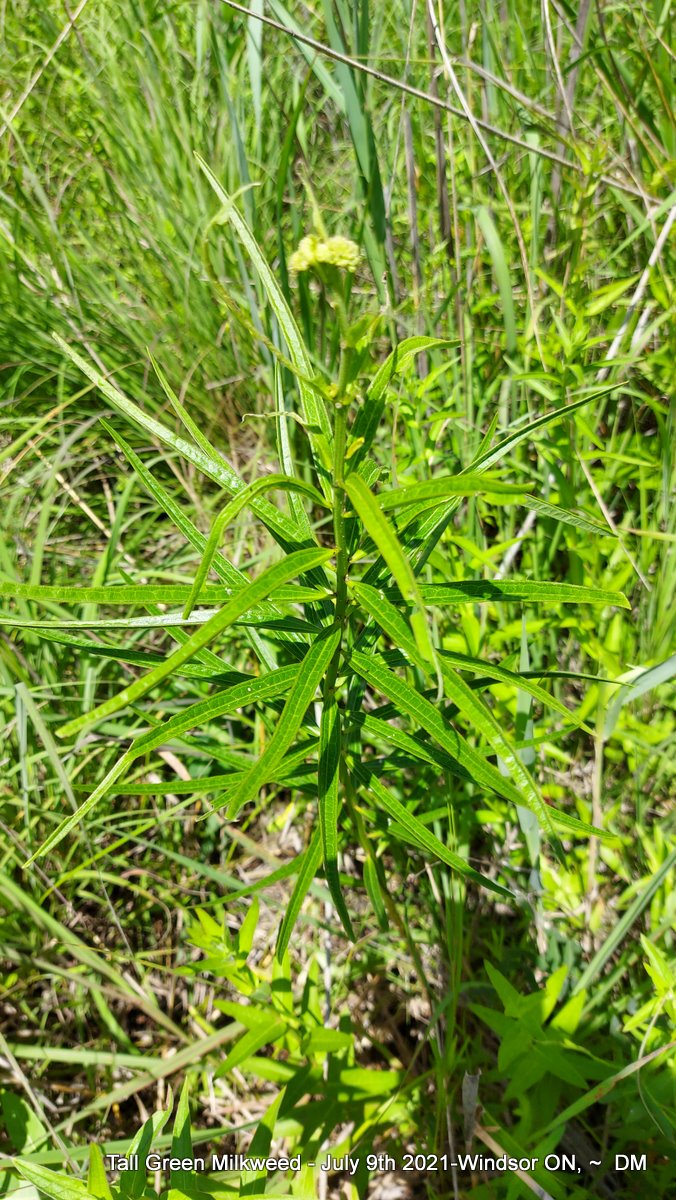
Speaking of rare milkweed plants, I had observed a single specimen of Tall Green Milkweed this summer as well (around early-mid July).  I had gone back a few weeks later to see this plant in full flower, but sadly, its flowers or the top of the plant had been gnarled somehow, perhaps deer herbavory?
Anyway - I have been a little busy with work/life but I still value the chance I have to blog some of my nature sightings. I think writing really lets a person think, reflect, share ... put ideas down into words. Perhaps create memories or give someone else a chance to see what I'm seeing in my little corner of the world. I really think botany is a great hobby, and I've enjoyed learning from the blogosphere of Naturalists that I follow. 

Good Naturalizing!

Dwayne

Saturday, August 26, 2017

Late August Botany Walk with the Essex County Field Naturalists' Club


This morning on Aug 26th, 2017 the Essex County Field Naturalists had two event offerings within the Ojibway Complex. One was a hummingbird banding demonstration at the visitor center, and the second option was to tour some of the botany features of the Chappus St. Ojibway Prairie fragment area (as well as the Spring Garden Study Area). I opted for the botany tour! Our tour leader was Russ Jones who is a botany expert that works in the natural areas surrounding the new DRIC (Detroit River International Crossing) bridge corridor.


The Chappus Street (Prairie remnant) area was adjacent to the DRIC project and was just starting to be developed into a residential neighborhood. The MTO bought the few houses that were just recently built and the surrounding land to compensate for the environmental destruction the DRIC highway caused on the Ojibway Complex. Had a proper environmental assessment been completed, no development should have been allowed in an area filled with endangered species. One interesting point that Russ made was that even though the DRIC bridge project had a huge environmental impact on the Ojibway complex, the fact that the Chappus street area was preserved and restored hints that there was a net positive effect on the area. This Prairie is arguably as biodiverse and filled with rare plants as the Provincial Ojibway tallgrass prairie, Tallgrass prairie preserve, or the Spring garden area.

Our group of about 12 nature enthusiasts walked through some amazing tallgrass prairie habitat. Some plants noted in the first few minutes were Willow leaf Aster, Purple Gerardia, Boneset and Tall Boneset, Ironweed, Seedbox, Colicroot, and countless goldenrod species.

At one point we entered a gated portion of the area and were lucky enough to see one of the rarest plants in Canada. Tall green Milkweed! Other excellent plants were Blood red Milkwort, Three awned grass, (cudplant?), Round headed bush clover, Tall Coreopsis,  Foxgrape, Hairy Pinweed as well many species of sedges and rushes that are rare in Canada. 


Later on in another area of the prairie we saw a few other rare plants including Narrow leafed Mountain mint (as opposed to the more common Virginia Mountain Mint), Winged Loosestrife, Culver's Root and others. One area was restored from a perfectly manicured lawn that was being maintained by someone who was extending their back yard onto this property.


One last point that Russ showed the group was the hibernaculum that were setup from basements that were developed along that road. The concrete and wood left over from the few demolished homes acted as a perfect backfill for basement foundations that would make great wintering habitat for then local endemic snakes (Fox and Butler's).

Later, we moved toward the Oakwood forest section of Ojibway and took note of the new bio-crossing passage that connects Oakwood with Spring-garden. This passage allows snakes, mammals and herps cross the 401 highway that has divided the two areas for decades. The genetic exchange that can take place with a passage way will increase the chance for the animal communities to be healthier and thrive. Some radio tagged snakes have used the corridor which proves its usefulness. 


We then were allowed to go to the spring garden study area which used to be a small (Reddock?) street with houses, but because of the DRIC project, needed to be expropriated. Indigo Buntings, Carolina and House Wrens were present as we looked at Tall Sunflower, Silky Dogwood, Flowering Dogwood, Whorled Milkweed, and American Chestnut.

Overall, I think the 12 participants to this field trip were amazed by the biodiversity of the sites that we visited and were very appreciative of Russ's time and expertise. It would be nice to have more botany walks at different times in the spring and summer to appreciate the botanical bounty that the Ojibway Prairie Complex has to offer. 

Good birding & botanizing,
Dwayne Murphy

Friday, July 8, 2016

Southern Ohio Roadtrip


This past weekend, my family and I went on a whirlwind Ohio roadtrip. The trip was initiated by my desire to go see a swamp metalmark at a natural area called Cedar Bog. Our trip would continue with  a stop in Columbus and another stop at Shawnee State Park. Sadly, this particular trip was a little bit of a dud - it rained almost constantly while we were at Shawnee.


Cedar Bog (its actually a Fen) was really nice. Just the plants in the parking lot alone were so beautiful, it almost justified the duration of the drive to get there. There was a small visitor center, and after paying a modest fee to go in, I noticed on the photocopied map that there was an X and some directions written in handwriting to the location of a Purple Fringed Orchid. Grass pink Orchids were still blooming in the Fen area which was really nice to see as well.


Cedar Bog was good for birding as well, but the most noteworthy bird was a Carolina Wren, which was singing its distinct four-part "Fee-Bay-Fee-Bee" song. You might be wondering --- did I find my target butterfly species - the Swamp Metalmark? No. I met up with a local lepidopterist as I was leaving and he hinted that my target butterfly has sadly been extirpated for the last 7-8 years. 

At Shawnee State Park, it rained for two straight days. Shawnee is a huge forest, 60,000 -70,000 acres of protected area. Just like my first trip there two years ago, it was almost pointless to see butterflies. Oddly though, there were a few nice nature sightings. While driving around, I heard Prairie Warblers singing near a recently clear cut area. A Louisiana Waterthrush was a cool find, as it was on the road (perhaps picking worms out of the puddles) as I was driving at one point. Other breeding warblers at Shawnee include Kentucky, Chats, Worm eating, Cerulean, Yellow throated and more.  Yellow fringed Orchid is reputed to be in some of the powerline clearings of the park but... did I mention the rain?


On our last morning of our trip, an employee at the Shawnee Nature Center suggested that I check out the Edge of Appalachia nature reserve, and specifically the- Lynx Prairie. This 18,000 acre natural area is almost adjacent to Shawnee and is privately owned by the Nature Conservancy. Of course , on the day that we were leaving, the sun broke out a little and we enjoyed a nice hike through a forest and prairie habitat. Upon arrival, just the parking lot alone revealed some nice butterflies - Several Pipevine Swallowtails and several Variegated Fritillaries among others. The prairie areas were a little quiet with a single worn Zebra Swallowtail, a single Banded Haistreak and two Juniper Hairstreaks. Whorled Milkweed and what I think is Scaly Blazingstar are two new botanical lifers. 


Seeing this in the Lynx Prairie might have been the nature viewing highlight of my trip. 


Its good to be back home though. I have been buried in home renovation projects and they have kept me from birding an botanizing as much as I would have liked to. Still, I've made some noteworthy sightings in my limited walks and I will leave that for the topic of my next posting.

Good Birding!
Dwayne

LinkWithin

Related Posts Plugin for WordPress, Blogger...