Showing posts with label Acadian Flycatcher. Show all posts

Tuesday, June 27, 2017

Northern Oak Hairstreak at Reid CA in Wallaceburg ON + ... wait for it... FOY Dickcissel in Lambton!

Northern Oak Hairstreak at Reid CA

Those that read my end of year summary (published back in Jan) might recall that one of my nature viewing goals this year was to finally catch up with the Northern Oak Hairstreak.  I must admit that I have tried at least once or twice for this butterfly in the past with and dipped. So this year, I made an honest effort to go see this butterfly in the middle of its flight time (June 20?). Kit and  I left Windsor at an ambitious time of 7AM and arrived (still early) at Reid Conservation Area, on the shores of the Syndenham River just a little ways north of Wallaceburg. It was still quite brisk and perhaps the butterflies were still warming up as we arrived. After searching for over an hour, I started heading out to the road. But, as luck would have it, an older couple arrived, and I figured I would see if they could have better luck finding this nickel sized fluttery beast. Also, a text message from Blake suggested to "be patient".  So... after about ten minutes with the older couple, I found a hairstreak walking along a stem several inches below the flowers of an Indian Hemp plant. This is my fourth buttefly lifer species this year, and I think I am at about 120 species photographed.

Northern Oak Hairstreak

An interesting thing about the Northern Oak Hairstreak is that there are two major types within the species. The primary type was called a Southern Oak Hairstreak, and when the northern species was added, they thought of calling the northern one a "Northern Southern Oak Hairstreak" and the southern version a "Southern Southern Oak Hairstreak". Now, they just call it an Oak Hairstreak and locals can add Southern or Northern as they like. 

Another interesting thing about this butterfly is that (as far as I know) there is only one population known in all of Canada - north of Wallaceburg, and it was Blake Mann who discovered it. Imagine looking at the field marks of a hairstreak butterfly (with its large white "M") and saying: "what is this? this isn't in any field guides!". So a special shout out to Blake for his keen observation and his leperodoptic contributions to Ontario and Canada butterfly watching.

Reid Conservation Area

*(note: as I write this posting tonight, I am listening to an Indigo Bunting singing in my back yard, with distant Wood Thrushes, Song Sparrows, Red bellied Woodpecker, House Wren and occasionally a Great crested Flycatcher! (ebird checklist)  Also, there are House Sparrows chirping... this is Windsor after all...)


Other butterflies seen include about 3 banded hairstreaks, lots of Common Wood Nymphs, Eastern tailed Blue, 1 Question Mark, 4 Eastern Comma, lots of small European Skippers, 1 Red Admiral and of course, 1 Oak Hairstreak. 


European Skipper on Indian Hemp


After seeing the hairstreak butterfly, Kit and I met up with Lambton birder Sean J who was checking out a hay field not far from Reid CA. Upon getting out of our car, we heard the songs of Dickcissel (FOY!) , Bobolink, Savanah  Sparrow, Eastern Meadowlark and more.


From this point, we had a decision to make - go to Strathroy for more grassland birds (Upland Sandpiper) or perhaps head back towards Windsor and stop by Rondeau and perhaps try for an Acadian Flycatcher (both of these would be lifers for Kit). We ended up going to Rondeau to try for the Flycatcher.


Good Birding & Lepping!
Dwayne

Sunday, June 1, 2014

Yellow headed Blackbirds at Mitchell's Bay

 Yellow Headed Blackbird - Xanthocephalus xanthocephalus
Its been well known and documented that Yellow headed Blackbirds have been breeding in Southwestern Ontario this spring at a Lake St Clair wetland near Mitchell's Bay.  I have been wanting to go out and see them and this past weekend May 24th),  I was able to finally get out and see them. It was nice to find them so easily along the road. Bright yellow heads, bold white wing patches visible in flight. Amazing birds! I did not stay long to see them (just 5-10minutes) but I must say, it took a moment for them to vocalize and when they did... wow. What a crazy song! It is described a loud rusty farm gate closing!

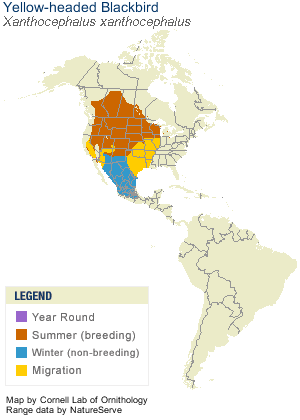
In my short 4-5 years of birding, I've only seen this bird once at Pointe Mouillee in Michigan, so its not a life bird, although, its my first Canadian look at them and my first photo and blog reference to them. Check out the range map from AllAboutBirds.org below. The E-bird range map for this bird (set for this year only) hints that this year, it is increasingly present on the eastern half of the continent.

Image Source: http://www.allaboutbirds.org/guide/yellow-headed_blackbird/id
Allen Woodliffe [Link], Blake Mann [link], and Josh Vandermeulen [link] all have excellent postings and photos on these birds. Check them out! Jean Iron also took some excellent video footage where you hear the incredibly unique call of these birds [click here for Jean's Yellow headed Blackbird footage] .


Family Rondeau Park Visit (Sunday May 25th)
I took the family out for some nature hiking at Rondeau this past Sunday. We walked Spicebush trail first. Some birds seen include:
Red-eyed Vireos
Red breasted Grosbeak
Thrush
Canada Warbler (its been a good year for me seeing this bird!)
American Redstart
Yellow Warbler

Tulip Tree Trail
Starting at the Beach, I had noted:
Eastern Bluebird,
Baltimore Oriole,
Spotted Sandpiper
(no whimbrels)
Wilson's Warbler
Bay breasted Warbler
Wood thrush
Acadian Flycatcher (90% sure - didn't hear it calling but did note quick, darty flight, eye-rings, mid-forest)
Eastern Wood Peewee
Yellow Warbler
Brown headed Cowbird (mid-forest???)
Scarlet Tanager
Prothontary Warblers (male and female)


Acadian Flycatcher? 90% sure!


Female Prothontary Warbler at Rondeau - Note the white undertail coverts

I was amazed as I drove around Rondeau how many Brown-headed Cowbirds were perched roadside and in and along the forest pathways. I'm not a biologist, but I wonder if culling these birds will ever be considered? Especially considering how much some of our rarer breeding species are declining. They had great results with a program in Michigan's Huron-Manistee forest where the Kirtlands Warbler breeds.

Good birding!
Dwaynejava

Wednesday, June 5, 2013

Acadian Flycatcher & Some Other Rondeau Gems...

This is an Olive-sided Flycatcher at Ojibway Park.  Great bird!


After work on Friday May 31st, I went for a walk at the Ojibway Tallgrass Prairie. I was hoping to find an influx of Indigo Buntings, but I still have not heard or seen many this year. I did see an Orchard Oriole, male and female Eastern Bluebirds and a few other expected residents. As usual, I had photographed a few skippers, Wood Nymph Butterflies and a few birds I had seen. A distant, tree-top bird that caught my eye was photographed, but seemed too far, too distant to even bother identifying while in the field. The white sky behind the subject made even visually recognizing it a little difficult.


Long story short, I was looking over the weekend at the bird on my computer and realized it was an Olive sided Flycatcher! This is my third Olive sided Flycatcher, and my first "northbound". A quick study of the pictures shows a white patch on the birds lower back (not its rump), dusky wingbars, dark face and white throat, short but notched tail, and a sharp contrasting 'vest' on its chest. I didn't hear it sing "Quick, three beers" but its tree top perch was telling as well.

This weekend, I attended the Skunks Misery OFO walk, and was saddened to not see my one target bird, the Acadian Flycatcher. (More on that trip in my next posting). Blake had told me during that trip that our missed target bird is pretty easily seen at Rondeau...

So on Monday June 3rd,  Jeremy Bensette and I decided we would meet up (after work) at Tilbury to do an Acadian Flycatcher trip to Rondeau. In a cruel twist of events, I had planned on talking with Blake over the phone about the bird's location, but he had his phone off that afternoon. That meant Jeremy and I would have to find  this elusive flycatcher on the 32 -square kilometer park. Well, we knew it was on Spicebush Trail, which rounded down the area we had to search. Luckily, the explosive Ka-ZEEP! call was heard soon after we started our search!

According to ROM, there are fewer than 40 pairs of Acadian Flycatchers in all of Canada. The Carolinian zone in Southwestern Ontario is the northern fringe of this bird's breeding territory. There are fewer than 20 sites that meet the Acadian Flycatcher's demands of a flooded forest floor or ravine, with a large amount of forest surrounding its breeding grounds, as much as 100m away from any forest edge! This bird will not nest in a forest with less than 25-30 acres in size (Ohio DNR).


The Acadian Flycatcher has a call that sounds like an emphatic "peet-za" or sometimes an explosive "ka-ZEEP" (ROM). Tonight, Jeremy and I heard and recorded the call. This bird must be identified carefully as it looks like many others in the flycatcher family. Its best identified by sound and habitat. Also noted was the birds quick, agile flight from perch to perch.

According to I-Bird, the name of this bird has an interesting origin. Fifteen species of flycatchers were at one point thought to be all the same. But slowly, the flycatchers were all sorted out and separated by subtle details in plumage, and more obvious details in their calls and habitat preferences. The original flycatchers were discovered in Acadia yet the Acadian Flycatcher is found more in the southeastern corner of the US, and not in the northeast. (I-Bird)

Flycatcher Calling Mnemonics:
Willow Flycatcher - Fitz-Bew (Brushy wet areas, more southerly range)
Alder Flycatcher -  (Raspy) Free-Beer (Alder Marshes, more northerly range)
Acadian Flycatcher - (Explosive) Peet-ZA or ka-ZEEP (Deep forest, with watery areas)


It was an amazing moment of birding when we saw this bird. In the background, Eastern Wood Pewee, Pileated Woodpeckers and Wood Thrushes were calling.  Wood Ducks and White tailed Deer came into view as well. 

Later, Jeremy and I found this Prothonotary Warbler. We watched a female forage for 5 minutes, then all of a sudden, the male came by and mated with the female right there in front of us! Jeremy saw the 2-second spectacle, but I missed it as I was 'chimping' my camera (chimping is when a photographer looks down at his/her DSLR screen and looking at their recent photos and pressing various buttons).


Jeremy Bensette heard a Chuck-wills-Widow calling near the visitor center.  Him and I both have the audio of it singing, but a curious aspect of his find is that it was only 6pm when we heard it. Another birder that frequents the Rondeau area checked for its call on and verified that indeed, there is a Chuck wills Widow singing near the Rondeau Visitor center around dusk. It took much effort, but I created a short video below documenting some of the sounds of today's trip...


As we left Rondeau, this Traill's flycatcher made an appearance. I feel it was either an Alder or Willow Flycatcher. Willow would be more common, but Alder's range does overlap at Rondeau. It didn't call, so we'll call it a Traill's Flycatcher, the name of the mix of Alder and Willow Flycatchers before they were distinguished as a separate species.

I was hoping this bird would call, but ... no luck it was silent and quickly dashed out of view

Other highlights today at Rondeau included: Pileated Woodpecker (heard drumming and singing), Red bellied Woodpecker, Downy, Hairy, (Red headed for sure but not seen in our short time). Woodthrush and Veery heard often. Black billed Cuckoo (heard). Scarlet Tanager and a nice female Indigo Bunting were seen close to the visitor center parking lot. We were really excited about this brief but productive visit to Rondeau!

Ebird Checklist by Jeremy Bensette: eBird Checklist – Rondeau Provincial Park, Ontario – Mon Jun 03, 2013 – 51 species http://ebird.org/ebird/view/checklist?subID=S14336472

Good birding!
Dwaynejava

Lifer Summary:
Acadian Flycatcher 333
Chuck wills widow 334

Sources and more reading:

http://publications.gc.ca/collections/collection_2011/ec/CW69-14-5-2010-eng.pdf
http://bna.birds.cornell.edu/bna/species/614/articles/introduction
http://www.allaboutbirds.org/guide/Acadian_Flycatcher/sounds
http://www.mnr.gov.on.ca/stdprodconsume/groups/lr/@mnr/@species/documents/research/stdprod_086350.pdf
http://ny.audubon.org/sites/default/files/documents/hrvc_acadianflycatcher.pdf

I-Bird, "Acadian Flycatcher", ND, WEB, June 5, 2013, http://identify.whatbird.com/obj/687/_/Acadian_Flycatcher.aspx

Ohio DNR, Acadian Flycatcher, ND, WEB, June 3, 2013,
http://www.dnr.state.oh.us/Home/species_a_to_z/acadianflycatcher/tabid/6531/Default.aspx

ROM, "Ontario's Biodiversity: Species at Risk - Acadian Flcatcher", Oct 2008, WEB, June 3, 2013, http://www.rom.on.ca/ontario/risk.php?doc_type=fact&id=121

LinkWithin

Related Posts Plugin for WordPress, Blogger...