Showing posts with label Lesser Yellowlegs. Show all posts

Sunday, October 18, 2015

Blenheim White-rumped Sandpipers & Some Vitamin N

White rumped Sandpiper at Blenheim

White rumped Sandpiper at Blenheim
Huge numbers of  White rumped Sandpipers have been showing up in Ontario during their southbound migration this year. Their main migratory path is through the central provinces and states. Ontario's blogosphere (See Mike Burrell's White Rumped Sandpiper Posting) and Ebird hinted unprecedented numbers --- flocks as 100-300 were seen throughout Ontario over the last month (sightings of 1-10 birds are normally expected). I wanted to witness this specticle over the last two or three weeks, but couldn't make it out to any good shorebird habitat till this weekend. I thought I had missed the boat - but a recent e-bird posting from just this past Wednesday hinted that many were still around, as many as 60 at Blenheim SL. So after work on Friday, I checked out Blenheim and was happy to see that there were still some good shorebirds to be seen. It was very windy and very cold. It almost felt like it was going to snow actually.

White rumped Sandpipers in flight - Their long primaries extend past their tails when at rest.

Birds seen include Willet, Greater & Lesser Yellowlegs, Pectoral, Dunlin, and of course --- White rumped Sandpipers. Several American Pipits were very present as well. Savannah Sparrows were seen as well as hundreds of Rudy Ducks and Northern Shovelers in the deeper ponds.

Blenheim Shorebirds - Labeled!

American Pipit


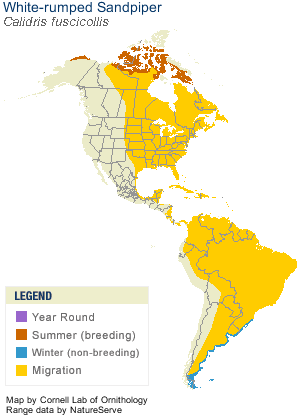
Img Src: https://www.allaboutbirds.org/guide/White-rumped_Sandpiper/lifehistory
White rumped Sandpipers have one of the farthest migrations imaginable - They breed in Canada's Arctic and they fly all the way to the southern reaches of South America during the winter.  Some cool things that these birds might observe in the Arctic Circle is the Aurora Borealis - Northern Lights. They might also witness the "midnight sun" which the arctic circle experiences - Several months of daylight - uninterrupted by a sunset and night time due to the tilt of the earth's axis.  It seems cool to think about how they chase the sun --- they are always in a constant Spring-Summer-Fall-Migrate cycle.  They arrive late in the springtime - as late as June and migrate south a little later as well. Its amazing to think that these birds , weighing only 1.4–2.1 oz (allaboutbirds) make all this effort to avoid winter and to have access to food. Its just part of their nature. Amazing.


Img Src: http://www.astro.washington.edu/courses/astro270/On-LineLectures/astro101s03_whereonearth.html


Img Src: https://en.wikipedia.org/wiki/Aurora


The local Essex County Field Naturalists group forwarded this video about "Vitamin N" (N for nature). Its a 10 minute presentation from an MBA grad student about nature. Its pretty good, and if you are reading this page... I'm sure you would agree whole heartedly with his message. One of the nature scenes that he provides looks to be Nova Scotia's Cabot trail if I'm not mistaken.

Click here for the link to the video: http://www.slideshare.net/StanfordBusiness/unplug-recharge-how-spending-time-in-nature-can-change-your-life

This article in the Windsor Star was about students planting Dense Blazing star in a small tallgrass prairie behind St Clair College.
http://windsorstar.com/news/local-news/threatened-prairie-plant-gets-boost-at-st-clair-college


Good birding!
Dwayne

Yellowlegs

Wednesday, October 1, 2014

ROM Butterflies of Ontario Field Guide Review plus Bonus Video: Vlogging Entimologists!


I recently ordered a copy of the ROM Butterflies of Ontario field guide online and obtained my copy today. I was a little reluctant to get a ROM guide after being a little disappointed with the ROM Birds of Ontario field Guide. The problem with the ROM birding guide was that only one image of each bird was provided, and that was a shortcoming of that book because birds can have many plumages due to age, time of the year and of course, sexual dimorphism.  My initial impression of this book though has been much better. The photography is excellent. The writeups are good and cover lots of information. The range maps are nice - customized to the province of Ontario and even include specific points that the particular butterfly has been found in. Data perhaps garnered from E-butterfly databases and other historic records.


The first section of the book is excellent and includes the following:
  • History of Butterfly study in Ontario
  • Butterfly morphology
  • Factors influencing butterfly distribution in Ontario
  • Conservation and protection of Ontario butterflies
  • Where to Observe Butterflies (including nice profiles of the top 14 butterfly watching sites)
  • Observing butterflies  and documenting records
  • Butterfly Gardening
The image below shows the first of 14 butterfly hotspots spread out throughout the province. It was great to read about Ojibway Prairie as one of the main featured areas for butterfly watching.  The next page features Point Pelee. Two hotspots in Essex County. Exciting!  I plan on making trips out to all these corners of Ontario during upcoming summers.

Each butterfly basically has a two page spread that includes great photography of both the dorsal and ventral view of the butterfly, as well as the larval form (Caterpillar). Occasionally, a host plant images is included as well. Range maps and distribution details are excellent.

I was wondering if some extirpated species were included in this book, and it seems yes, they are. I think field guides and other books relating to natural history should include extinct and extirpated species, just to remind us of what should be here and to remind us that we need to increase conservation efforts.


Well, here is the promised video. Its not really a Vlog (Vlog is short for Video Log or Video Blog), but rather, a recorded webcast... But I just thought it would be cool to say: "Vlogging Entimologists"! Its interesting to watch these two ROM authors just sit around and talk about butterflies in Ontario. Its nice to see the authors behind the books you are reading. Enjoy!


One might be curious to know how this guide compares with the recent and excellent Kaufman butterfly guide? I think they are both great, but the ROM guide simply focuses on the Ontario species whereas the Kaufman guide tackles a much larger area: All of the US and Canada! Its a matter of depth versus breadth. So, since so much breadth is covered in the Kaufman guide, there is not much depth. The ROM guide provides much more depth, but less breadth. Both are excellent.


There was some interesting discussion about this field guide on the Ontario butterflies google group. There were some criticisms about inaccuracies in the book or mistakes... perhaps made by inaccurate data entry or mistaken observations.  The debates were interesting, and at times somewhat heated... But rest assured it remained civil :-) One butterfly enthusiast made a comment that... (I forget the context of his discussion - perhaps regarding the data discrepencies and the volunteer efforts to fix them) but he mentioned that we are all paid in "butterfly bucks"... Too funny.

I plan on reading this book and just leaving it on my coffee table for my kids to flip through. I recommend getting it!


Good Birding & Butterfly watching!
Dwaynejava

At the time of publishing, this book is 37% off the cover price at Chapters/Indigo. See link below.
http://www.chapters.indigo.ca/books/the-rom-field-guide-to/9780888544971-item.html


Sunday, August 19, 2012

Red necked Phalarope at Point Pelee's Lake Pond


With numerous Ontbirds postings over the last week about Red necked Phalaropes I figured I would make an attempt (my last for the season) to kayak Point Pelee's Marsh (Lake Pond) and find them myself. Sure enough, a pair was spotted at one of the first "Islands" that I visited. The black streak across the eye is easily seen from great distance! One of the two Phalaropes had some golden highlights in its plumage, and the other was monochromatic.


Like I've said many time before, it seems shorebirds ignore people when they are in a kayak. I was about 5 meters away from these two Phalaropes, a Greater Yellowlegs and a few Semi-Sandpipers. At one point, they flushed because of a Northern Harrier that flew by, but then returned immediately.

Some birds that I saw today (Saturday) include:

Red necked Phalarope  2
Short billed Dowitchers 20
Black bellied Plovers 3
Least Sandpipers 30
Semipalmated Sandpipers 30
Yellowlegs Sp. 6
Semipalmated Plovers 5
Spotted Sandpiper 5
Killdeer 10

Perhaps more diversity could have been found by navigating to other areas of Point Pelee's Marsh (see map), such as West and East Cranberry Pond, but as usual, I only had a few precious hours to bird on Saturday.
I was hoping this was a Western Sandpiper, but no, its Semipalmated.
Yellow legs
Butterfly Watching
 
A ditch on the nortwest side of the road leading to Point Pelee had about 20 meters of Purple Loostrife and many butterflies had taken notice. Whites, Sulphurs, Painted Lady, Monarch, Common Buckeye, Grey Hairstreak, Fiery and Sachem Skippers were all present. 

Earlier on in the week, I had photographed this Duskywing below. I had heard about some duskywings having a plume on their hindlegs, so I thought I had found something interesting here.  An online book I found while researching (Butterflies of Canada) mentioned that the following duskywings have such plumes: "Male duskywings of Icelus (Dreamy Duskywing - Too late in the season), zarucco, Funeralis, Persius (Persius Duskywing), Lucilius (Columbine), Afranius (Afranius Duskywing), and Baptisiae (Wild Indigo) have hair plumes on their hindlegs. So, considering the time and location, I think its just a Wild Indigo that had its wing oriented with the sun in a way to show some really nice iridecsence. The four white spots are hardly visible in this photo, but in others they are visible from the underside of the forwing.

Iridescent Wild Indigo Duskywing, with plumes on hindleg

Ventral View of a Tawny Emporer
Sunday Visit to Holiday Beach

Some of my best birding trips in my short three years of birding have been at Holiday Beach (Warblers peaking on Labour Day Weekend), and today gave me a little taste of what is to come over the next two or three weeks. Since May was a such a letdown in the warbler department, I look forward to enjoying vireos, flycatchers and warblers, as well as Raptors on their Southbound migration over the next month. Holiday Beach is one of North America's best Raptor Migration hotspots.


Some birds seen at Holiday Beach include:

Hundreds of Great Egrets
Many Great Blue Herons
Heard Carolina Wrens (many)
Cedar Waxwings (many)
Eastern Wood Pewee
Alder Flycatcher
Black and White Warbler
Cape May (or Magnolia) Warbler
Yellow Warbler


Hundreds of Egrets are still at Big Creek. This is a split photo, the top looking north from the big creek bridge, the bottom looking south. I looked for wing-tags but saw none.


Good Birding,
Dwaynejava

Wednesday, July 27, 2011

Five lined Skink and other Pelee Flora and Fauna


I've never seen a Five lined Skink before so I figured I would go to Pelee today an try my luck at finding it. I heard that they can be found on the South side of the visitor center (they like the warm bricks) and around the West Beach access paths. I think one thing that prevented me from seeing it earlier is that its size is so small. Its probably only 2" long and quickly run off the west beach access paths as you make yourself visible to them. The five lined skink is one of only five lizards that are native to Canada's geographic regions. See this site for more details: http://www.simplywildcanada.com/Lizards_of_Canada.html .

I walked the West Beach footpath to the tip parking lot and saw tonnes of butterflies. Most numerous today was Giant Swallowtail, Eastern tiger Swallowtail, Common Buckeye, Monarch, and singles of Hackberry Emperors and Red Spotted Purple. Summer Azure was abundant as well. There is a tonne of Common Knapweed along West Beach. This is good for the butterflies even though its a non-native species. It thrives in the dry, hot environment on the West Beach. The park wanted to remove Common Knapweed as discussed in this Windsor Star article.


Summer Azure
 Hackberry Emperor (butterfly lifer)- This actually landed on me!
 Common Buckeye
 Giant Swallowtail on Common Knapweed. Common Knapweed is abundant on the west beach...
Common Buckeye on Prickly Pear Cactus

I also kayaked the Point Pelee Marsh and headed straight to the small islands of muddy sediment that attract shorebirds. Some seen today included Semipalmated Plover, Least Sandpiper, Lesser Yellowlegs ... and I must confess I've had a tough time identifying some of the birds. My problem with identification is the following: Least and Semipalmated Sandpipers are very close in size (6-6 1/4"), but there was a shorebird that was noticibly larger...possibly a Sanderling? Sanderlings are small, but still about 2" longer than Semipalmated Sandpipers and look very similar, at least in my interpretation of my field guides.


 Sanderling? It's more than a 1/4" bigger than the Least Sandpipers... Do Sanderlings hang out on mudflats? It was also 'running' as it chased the Least Sandpipers.
Three of these 4 shorebird photos are obvious. I have a feeling I've botched the second last photo. What looks like a Semipalmated Sanpiper but is slightly larger? Any shared identification thoughts or ideas would be appreciated. I will check out these mudflats again in August. Hopefully something good shows up!

Good birding,

Dwaynejava

Saturday, September 25, 2010

Hillman Marsh & Point Pelee in Late September

 Wing-tagged Egret 10E at Hillman

Even though my birding travails as of late have been basically fruitless, I couldn't help but stop by Hillman Marsh this morning. When I arrived, I walked over to the bridge over Hillman Creek,  and I quickly noticed a wing-tagged Egret! I was going to add a caption.. "don't label me" (to the photo above)... but when I add captions lately, it prevents the reader from seeing the larger version of the photo. Some Yellowlegs and some peeps were around Hillman this morning, but nothing overly exciting.


 I might be wrong on the ID here, but this shorebird was quite larger than those around it and has a slightly upturned bill. The Sibley field guide to Eastern N American birds statest that the bill length of a Greater Yellowlegs is about 1.5x the length of its head (Lesser has a bill length equal to the length of its head). Having seen many Solitary Sandpipers lately, I'm actually amazed at how similar they look to the Greater & Lesser Yellowlegs!


I then proceeded to Point Pelee and headed straight to the visitor center. I had read on the Point Pelee Twitter page that there were many Kinglets and Vireos lately. I was hoping the sightings book would hint at where to find them. But the sightings book listed exclusive raptors over the last few days.  I figured I would go to the tip of the park. There seemed to be very birds on my last two PPNP trips. Are the raptors scaring them away or am I just missing them???


The tip of Point Pelee was very sparse this morning when I went,  and I saw very little with the exception of one small pocket of passerines along the east beach about 20m south of the 42 parallel path.

  Yellow Rumped in great light and razor sharp focus... Click for larger view...

In a fleeting 2 minutes I saw:
Red Breasted Nuthatch
Flycatcher
Yellow Rumped Warbler
Cape May Warbler
Nashville Warbler
American Redstart
Blue Jays

Above them were
Red Tailed Hawks
Turkey Vultures
Sharp Shinned Hawks
Merlin/Peregrin Falcon

 I ran into Rick from Leamington as I was leaving the park and we quickly checked out Delaurier for some Golden Crowned Kinglets that he had seen earlier. Rick has taken some incredible photos and video footage since I've seen him last. I would like to publish some of his video or at least link to them if he puts them online.


Merlin or Peregrine Falcon? My field guide isn't helping on this one.

Overall, I find that the passerine migration has really slowed down, at least from my meager observations. I wish I would have seen a Lincoln's Sparrow or some Vireos, but I guess some Raptors and a tiny group of warblers will do.

Good Birding!
Dwayne

Bonus: Last night after work, I saw this Solitary Sandpiper at Ojibway Park. ... But not much else!

LinkWithin

Related Posts Plugin for WordPress, Blogger...