Showing posts with label Black Billed Cuckoo. Show all posts

Tuesday, June 10, 2014

Birding Carden Alvar in Early June


Well, two years ago at about this time, I had visited Carden Alvar [link] for a 1-morning birding trip and now, two years later, I went back this time for a full weekend (with family in tow). I felt more prepared, more capable this time around.  Amazingly, I only spent a small amount of this trip birding. I birded from 6am till about 9am both mornings, and that was it! But, as most readers are probably well aware, birding at 6am is just so much better than birding in the afternoon... the difference is night and day!

Brewster's Warbler - A hybrid between Golden-winged and Blue-winged Warblers

I had three major target birds and three target butterflies: Eastern Whip poor will, Golden winged Warbler and Sedge Wren and the desired butterflies were: Silvery Blue, Common roadside Skipper and Milbert's Tortoiseshell. Amazingly on Friday evening when I arrived to the Carden Area, I had a cottage near Lake Dalrymple and Alvar Road. I heard and recorded the Whips basically upon arrival! Saturday morning was gorgeous and was able to find Golden winged Warbler, (Brewsters as well) and hear Sedge Wrens. 

This was my first look at Golden winged Warblers - after 4 years of birding!
On my second morning at Carden, I was driving down Wylie Road when I heard a Grasshopper Sparrow singing its very distinct buzzy song. It took me a few minutes to find it, but while walking along the road, I flushed a Black billed Cuckoo from a nearby bush.  This is what makes Carden so amazing! Eastern Meadowlarks, Bluebirds, Brown Thrashers, Bobolinks, winnowing Wilson's Snipe, Alder Flycatchers ("free-beer"), Singing Hermit Thrushes (almost as beautiful a song as Wood Thrushes), American Bitterns filled the air with song. Sedge, Marsh, House and Winter Wrens can be heard in their respective habitats.

Grasshopper Sparrow - Singing along Wiley Road
Black billed Cuckoo
Savannah Sparrow
Along the edge of Sedge Wren Marsh lots of Eastern Phoebes were singing, as well as Alder Flycatchers!


Virginia Rails... The second time I've actually seen one in my life!
On my second morning of birding, I pulled out a point and shoot camera to take a photo of the Sedge Wren Marsh, when I noticed a large bird walking along the road! Virginia Rail! Later, (in another location) I had seen another Rail flush and heard another that stayed put - squacking. It gave brief views walking along a shallow marshy area and I then noticed two black downy chicks walking off to the side. Amazing birding! It goes without saying that for these breeding birds, I did not play calls or so much as pished. Just walk quietly and patiently before the crowds arrive and enjoy nature as it presents itself to you.

Some butterflies seen were: Canadian tiger Swallowtail, Silvery Blue, Tawny Crescent, Northern Crescent, Tawny edged Skipper, Common Ringlets. I missed out on Common roadside Skippers even though I did look for any skippers I could find.


Silvery Blue - Easily seen at Carden Alvar and a life butterfly!
Silvery Blue - Dorsal and Ventral Composite

Tawny Crescent - Life Butterfly

Check out this video which shows my first Eastern Whip-poor-will, Sedge Wren as well as Virginia Rail. I would have liked to have actually seen Whip-poor-wills which often fly at dusk... But crepuscular birding is so hard because that's when I'm putting the kids to bed!

Two of my three target birds were experienced through sound, which I captured with video. If you listen closely, you can hear sedge wrens and whip-poor-wills singing along with bonus Virginia Rail footage.


I did look for the Shrikes which were reported near Bluebird Box #10, but did not see them. I spoke to some birders who told me they were visible with scopes but I did not bother. I had seen them two years ago much closer to the road and with my limited time, I wanted to focus on other things.

Good Birding & Butterfly Watching!
Dwaynejava


LLS:
Whip poor will, Golden winged Warbler, Sedge Wren (348, 349, 350)

Carden Alvar Resources, Maps and Links:


http://www.jeaniron.ca/CardenAlvar/cardenalvarindex.htm

http://dwaynejava.blogspot.ca/2012/05/birding-carden-alvar-in-late-may.html

http://www.ofo.ca/reportsandarticles/cardenalvar.php

http://www.couchichingconserv.ca/wp-content/uploads/2011/11/SMSDesign-CardenTrails-finalREV.pdf

http://www.couchichingconserv.ca/wp-content/uploads/2011/11/Nature-Guide_PROOF.pdf

https://maps.google.com/maps/ms?msa=0&msid=204958277861725901559.0004a838e2203330f980c&dg=feature


Monday, May 28, 2012

Birding Carden Alvar in Late May


 For about two years, I've wanted to join the Ontario Field Ornithologists during their tour of the Carden Alvar, in the Kawartha Lakes region of Ontario. According to the Ontario Field Ornithologist's Carden Alvar Birding Guide, they make the bold statement claiming the awesomeness of the main route in the area: "Wylie Road is the best early summer birding road in southern Ontario. ....its the last Canadian stronghold of the Eastern Loggerhead Shrike in Canada and it has high populations of grassland and scrubland birds such as Upland Sandpipers, American Kestrels, Common Nighthawks, Eastern Whip-poor-wills, Eastern Bluebirds, Brown Thrashers, Golden-winged Warblers, Bobolinks, Eastern Meadowlarks, Eastern Towhees, Clay-colored Sparrows, Vesper Sparrows and Grasshopper Sparrows."(Pittaway). The OFO trip was to take place on Sunday, but since the weather forecast had 75% chance of thundershowers I hedged my bets and went on Saturday, by myself. Looking at the report by the group leader that was published to ontbirds listserve, I would have seen more with the group.

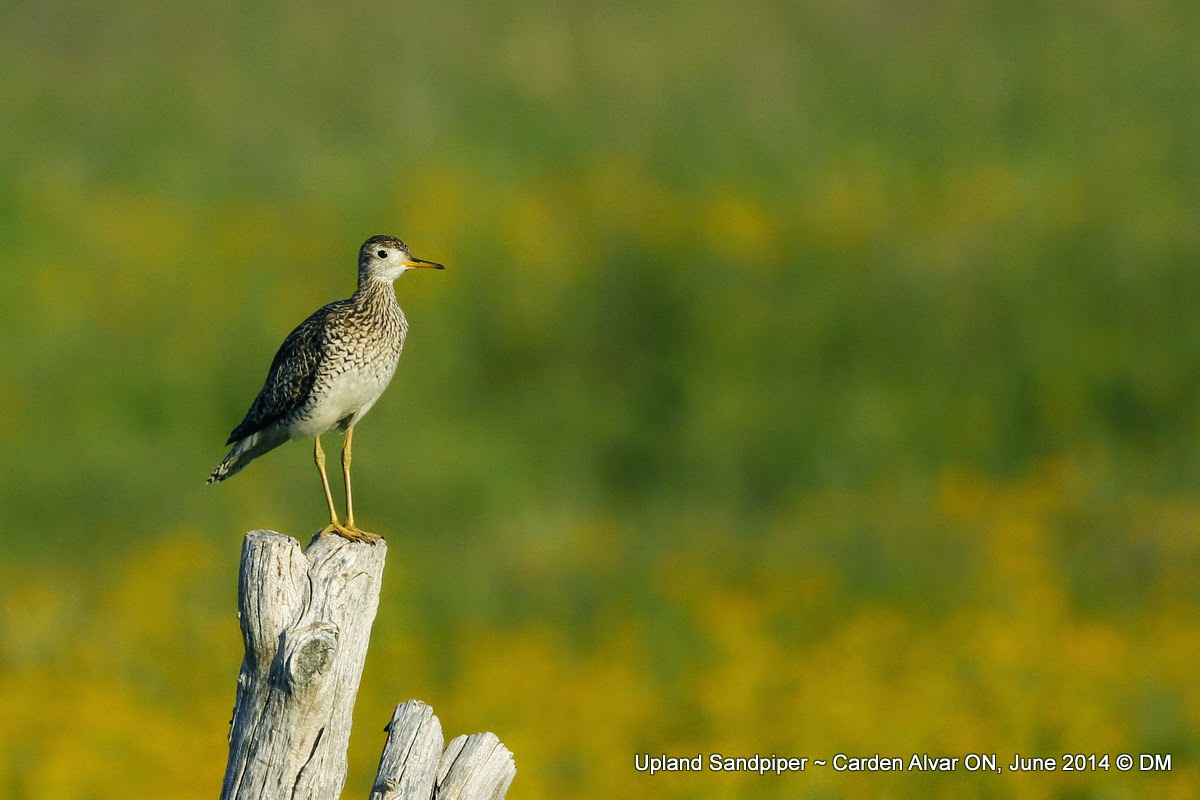
Wylie Road's infamous "Bluebird box #10" was great. Looking east, I found a Loggerhead Shrike (distant and cropped) as well as smashing views of a mating pair of Eastern Bluebirds. Brown Thrashers, American Goldfinch, Eastern Phoebe, Savannah Sparrows, and more were easily seen. I also saw an Upland Sandpiper for about 2 seconds as I was about to leave, but I'm not quite ready to claim it as a lifer, as I saw it while scanning the horizon with my bino's and it had landed behind a small hill, out of view.
Loggerhead Shrike... In Ontario... Incredible!


Sedge Wren Marsh was really nice. It was not what I imagined it would be. It was surprisingly small and had a single lane gravel 'bridge' crossing over it. Sadly when I arrived to the nature path on the south side of the marsh, four men were laying on the ground playing a looped track of sora, virginia rail and american bittern. They had tripods with whimberly heads and huge lenses. ... I was really bothered that they were doing that, but kept my mouth shut and walked away. Back on the bridge, I saw an amazing American Bittern just perched 30m west of the bridge, giving nice sun lit front views of this rare bird. Later on, the same group of photographers that were playing the looped track set up on the bridge, and started booming american bittern calls. So, I spoke up and told the guy, "Come on, the bird is 25m away... There is nowhere for him to perch even if he does come closer". These photographers assured me not to worry, that early birders shot birds and that he gives his photography on the web. I could elaborate more but will spare you the rant. These photographers didn't even have binoculars. I don't think they are very concerned about the welfare of the birds.

I was hoping to see Sedge Wrens, but only saw Marsh Wrens (and House Wrens). I did see many little brown jobs but made no definite ID any of the rare Sparrows that are known in the area like Clay Colored or Grasshopper. Many of the sparrows were Savannah or Swamp Sparrows from what I could tell. Even the OFO trip report mentioned that this year was the first year in many years that the group did not get Sedge Wrens.

Almost every birder I saw told me how I just missed Golden Winged Warbler and to just listen for them, but no dice. It would have been nice though!

300th life-list bird!
Amazingly, this was my only life bird for the day. This is my 300th bird on my life list, found basically on my 3rd year birding anniversary. American Bittern is decreasing in numbers due to destruction of wetlands.
I spoke with several birders looking for tips on seeing Upland Sandpiper and they had found them (perched on posts), and were looking for Snipe. Its funny how different people will see different things.
 
 Even though I've seen many Yellow bellied Sapsuckers, seeing this was one of my day's highlights. It was hammering away on this wooden post just meters from my car. I just love woodpeckers. Their behavior and gestalt is so cool. I took a 1-minute video and will post it in my next blog posting.
American Kestrel, Northern Harriers made their promised appearances, but interestingly, one bird I thought was a Kestrel was really a Merlin. I wonder if Merlin are increasing at the expense of Kestrels? Also, was the presence of Kestrels and Merlins the reason I dipped on Upland Sandpiper?
Bobolinks and Eastern Meadowlarks, as well as Brown Thrashers were numerous and filled the air with their songs.

 Below is a picture of the famous Prairie Smoke wildflowers as well as others (Indian Paintbrush?)

One disheartening aspect of the Carden Alvar area is the number of signs around stating "Government Back off" and "This is our land" etc. It was the same thing I saw in the White-Lake area of Penticton BC. Any efforts to conserve land seem to be bitterly disputed by various groups (the local gravel companies in Carden's case). I even witnessed a run-in between a land owner yelling at birders, and then later 5 or more fire trucks barreling down Wylie Rd over the course of an hour. I can't help but think a message was being sent but maybe I'm over-reading the situation. Even last year's OFO Skunks Misery field trip had its helping of drama with a man on an off-road motocycle yelling at our group of birders about ownership and usage of the land.

Jean Iron found this Black billed Cuckoo while leaving the Sedge Wren Marsh Trail

Getting back onto the topic of birding, having only one lifer was not a disappointment for me. I really had soul-satisfying looks at the American Bittern, which I was not expecting to see. I also saw and heard so many birds it was incredible. Many other birds were seen at Carden that I did not mention such as Swallows, Indigo Buntings, Yellow Warblers, Towhees, and even a Scarlet Tanager. I had momentary glimpses at Upland Sandpiper, and believe I heard Sora and the grunting call of Virginia Rail which was exciting, but I still don't want to count them as lifered. I also saw the handywork of a Pileated Woodpecker that did major damage to a snag along a wooded part of Wylie Road. I'm disappointing also not to yet see a Golden Winged Warbler but that will have to wait for the next time. Next year, I might try to go again but for three days and hopefully bring my family along.

Good Birding!
Dwaynejava

PS: If you consider going to Carden, make sure to read the excellent resource provided by the Ontario Field Ornithologists below. It was such an impressive and well put together resource. Thanks OFO and Mr Pittaway.

Sources:
Pittaway Ron, "Carden Alvar Birding Guide", Ontario Field Onithologists, ND, WEB, May 27 2012, http://www.ofo.ca/reportsandarticles/cardenalvar.php


Bonus Video:

Sunday, May 13, 2012

Nice looks at Yellow & Black billed Cuckoos

Birded Pelee again today (Saturday), really hoping to see more variety in warblers but left the park disappointed. As I left Pelee, I thought about going to Rondeau, but I realized I had a conscientious objection with paying $17 to walk around a park and bird. But much to my chagrin, upon arriving at home, I read the the daily report from Rondeau (which is about 1 hour north of Point Pelee) describing the warbler concentration as: "Warblers were dripping from the trees" ... Should of went there! Also, other birding reports today from Ontario have small municipal parks in Toronto (Colonel Samuel Smith Park?) with seemingly better numbers than I've been experiencing at Pelee.

On a good note, I did see lots of non-warbler passerines. Indigo Buntings, Cedar Waxwings, Rose breasted Grosbecks, both Cuckoos  (black billed self discovered). Red-eyed and Warbling Vireos were seen and heard. Another highlight for the day was watching a Red-eyed Vireo preen for several minutes in Sparrow Field.  Regarding shorebirds, Semipalmated Plovers were seen in numbers at Hillman, but not much else has changed in the mix there.

Is it just me or are things slow this year? Where are the warblers this year? Wilson's Warbler was nice to see today, but, not as nice as a Canada, Cape May or Bay Breasted Warbler. Maybe it was early leaf-out, or I'm getting lazier, not looking up as much, or the ban on pishing!


Last year on the 15th of May, I had an incredible birding trip to Hillman Marsh. That may have been one of the best warbler viewing days in my short three years of birding. Click here to revisit that amazing day...

Good Birding,
Dwaynejava

PS: St Lawrence Islands National Park is using some of my photography in their printed materials!
PSS: I took these sunrise shots with my latest lens, the Canon 10-22mm!


Saturday, August 27, 2011

Black billed Cuckoo, just by chance!


I woke up early today and did the typical Tilbury/ Hillman Marsh/ Point Pelee circuit with little to show for it!
Its hard to beleive that last year at about this time, I saw my 200th bird, the Solitary Sandpiper. I've painstakingly added 78 more species since then... will I make it to 300? :^)

Tilbury - As Blake mentioned, the shorebird cell is almost completely dry, just a few square meters of water left, concentrating the few shorebirds to a small area near the dyke road. Nothing new or noteworthy. Long billed Dowitchers, Solitary Sandpipers, Least and Stilt Sandpipers with two species of Plover.  I noted several Horned Larks (with Killdeers) on the gravel roadway as well.

Hillman Marsh - Many Egrets, GB Herons, Green Herons, Belted Kingfishers, were around. No surprises or rarities seen. A Common Yellowthroat and a Marsh Wren were making noise in a Phragmites thicket near the wetland cell.

Point Pelee's Marsh - I kayaked Point Pelee's Marsh and saw all the same birds as last week. Black bellied Plover (no Golden Plover yet!), Short billed Dowitcher, Stilt Sandpiper, Spotted Sandpiper were seen. West Cranberry Pond had an assortment of gulls, shorebirds as well as hundreds of Cormorants were seen. Two raptors seen in the marsh were a distant Northern Harrier and a Juvi Bald Eagle which flew almost 20m over my head. Pretty cool but not shocking... . I wanted to bird other parts of Pelee, possibly to find a rare flycatcher (yellow bellied or olive sided would be lifers) but as usual, I ran out of time. 


I spotted a spotless spotted sandpiper. The baring on its back is diagnostic for juvi's.
The highlight of the day was driving through the onion fields and noticing my friend Rick from Leamington. We drove by each other and then Rick did a three point turn. We pulled up to each other and talked a little about life and work. As we spoke, I noticed a large, skulking bird with an oddly horizontal posture. Black billed Cuckoo, photographed from my car. Notice the red eye ring and long tail extending below the branch!


Next weekend, I would like to check out Holiday Beach for warblers and possibly a trip to Pointe Mouillee in Michigan for some shorebirds. Last years trip netted 10 lifers... Buff breasted Sandpipers and Marbled Godwits to name a few.

Good birding,
Dwaynejava

Saturday, May 14, 2011

St Clair NWA and Rondeau Birding Pt 1 of 3


As mid-May rolled around, I figured I would spend a day at Rondeau to change things up a little from the normal Pelee routine. I woke up super early and headed out to Rondeau... but at the last minute, I tried to see if my new GPS knew where St Clair NWA was. My query was quickly answered with both good and bad news. Yes, it new the spot, but a surprise was that it took alot of time to get there and then get back to Rondeau. Almost doubling the trip time. I did not see too many noteworthy birds at St Clair NWA... but I was only there for 30-40 minutes. I saw American Coot, but did not even see a single Great Blue Heron ... I did see a Black Crowned Night Heron outside the Nature Reserve in an irrigation ditch.

One nice thing about the trip was the discovery of a new observation tower. One has been missing for over two years.

I later made my way to Rondeau and paid a good part of $20 to simply enter the park. Is it me or is that a little expensive??? Rondeau was extremely quiet on the morning that I visited. Spicebush trail netted almost nothing other than RB Grosbecks and yellow warblers. Tulip Tree trail produced a single Swainsons Thursh and distant sounds of what must have been Pileated drumming.
 This Purple Finch was with a few females. Sadly, his other eye seemed to be impaled/diseased.
 Pine Siskin have been refered to as American Goldfinch in Camoflage.


A Mourning Warbler was spotted, and later a Black Billed Cuckoo thanks to some photographers that caught my attention as I was leaving the park.


I left Rondeau before noon to maybe try my luck at Hillman/Pelee.

Good Birding,
Dwaynejava

LinkWithin

Related Posts Plugin for WordPress, Blogger...