Birding, Biking, Kayaking and Nature loving in Windsor Essex County in Ontario Canada
Showing posts with label Kirtlands Warbler. Show all posts
Tuesday, May 19, 2020
Birding Rondeau May 16th 2020 - Kirtland's Warbler Amazes
On Saturday May 16th, I figured I would go to Rondeau Provincial Park as the park had just become open to the public the day before - but I was unable to go due to work commitments. It was a gorgeous day and the birding was exceptional. I had seen Blake as well as many other birders out.
A Chatham-Kent birder named Peter Burke found a Kirtland's Warbler in the Rondeau Camp ground area and many were alerted to its presence. Amazingly, I was able to catch up with the bird and obtain a couple of record photos of the bird.
I will repost a little background history of the Kirtlands Warbler that I had posted a few years ago from this posting: https://dwaynejava.blogspot.com/2013/05/kirtlands-warbler-at-pelee.html
A Brief History of the Kirtland's Warbler:
Discovery in 1851 - A specimen was shot and collected on Dr. Jared Kirtland’s farm near Cleveland, Ohio(US FWS). The birds name obviously honours its finder . Oddly enough, 1851 was the year John James Audubon died. It must have been amazing to discover a new bird that was never described!
Wintering Grounds Found in 1879 - The winter range of the Kirtland's warbler was discovered in 1879 when a specimen was collected on Andros Island in the Bahama Islands archipelago.(Michigan DNR)
Breeding Grounds found in 1903 - It was not until 1903 that Norman A. Wood discovered the first nest in Oscoda County in northern lower Michigan (Michigan DNR).
Jack Pine Habitat Requirements:
-Requires pine habitat with trees between 6-20 years old.
-Prescribed burns (or logging) has provided more optimal breeding habitat for the birds.
-Kirtlands Warblers prefer a nesting site with Blueberry bushes as that is a favored fruit of this bird... cool!
-Michigan and US Wildlife employees have done an amazing job helping this bird's population recover.
-A successful breeding nest was discovered at Petawawa Ontario in 2007 (Drake).
Cowbird Parasitism:
Besides it habitat requirements, Cowbirds had been hurting the breeding success rates, so a successful cowbird management program has been put in place to reduce the numbers and increase the nest success for the Kirtlands Warbler.
Improved Outlook for the Future:
This chart below shows a trend in the number of singing male Kirtlands Warblers in Michigan. Since 1990, a continual increase in the number of singing males is evident. Props to Michigan and the US-FWS for putting resources towards saving this wonderful species. I'm just a humble birder from Ontario, but perhaps Michigan should consider changing its state bird from the American Robin to the Kirtlands Warbler? :-)
Image Source: Michigan DNR
Its always a pleasure to see this species!
Good Birding,
Dwayne
Thursday, May 12, 2016
May 11 & 12th Highlights - Kirtlands, Cerulean, Golden winged and More
On Wed May 11th, I went to Point Pelee after work as the daily report hinted that it was an excellent day to be at Pelee. Some birders hinted that it could have been the best day in ten years. It was good but I don't know if it was any better than a good day from last year. On Wed, I caught up with a Cerulean that was report at the Northwest Beach parking lot. Later, I went to the West beach footpath and had really close views of a Kirtland's Warbler! The Kirtlands was skulking around in some low lying dwarf juniper plants. Occasionally it would pop into view -at point blank range - then go into skulking mode again.
I took the day off on today, May 12th and had a pretty good day. I stopped off at Hillman first - and there was not much around in terms of shorebirds. So I went to Pelee. I had to park at Delaurier - and walk the anders footpath to tilden. Today was excellent for birding but of course, yesterdays volumes of birds were not present.
I saw this Northern Parula at eye level near Cactus Field. It was singing its heart out in the early morning light. Its so small, it took me a few moments just to find it.
I then took the tram to the tip - in hopes of finding a Cerulean and Yellow billed Cuckoo. The Cerulean was amazingly close to the trail, and singing its heart out. I took boat loads of photos but they were poor as the lighting was terrible.
Next- I ended up trying to go to "Dunes" which had a recent sighting of Golden Winged Warbler! I took the tram back to the VC and walked---- 2km??? Birding is great exercise isn't it? I was able to find the Golden Winged and later I ran into J.B. and Jeremy Bensette who were looking at YB Chat!
I birded with Jeremy and Tim(?) for the remainder of the afternoon. We attempted to see the Kirtlands again this afternoon but couldn't find it. Along west beach footpath, our consolation birds were: Wilson's, Cape May, Scarlet Tanager, and Morning Warbler!
Good birding!
Dwayne
Friday, August 1, 2014
Kirtland's Warbler and Karner Blue Butterfly - A trip to Pure Michigan
| Karner Blue Butterfly at the Michigan Nature Association's Newaygo Karner Blue Sanctuary |
There's an old saying in Michigan that goes like this: If you seek a pleasant peninsula, look about you! How true it is. I had two "bucket list" nature goals that have been bugging me - I wanted to really make an effort to see a Karner Blue butterfly, and I also wanted to see a Kirtlands Warbler in its breeding territory - Crawford County Michigan (Greyling Michigan).
![]() |
| Map of Karner Blue Sanctuary in Newaygo MI |
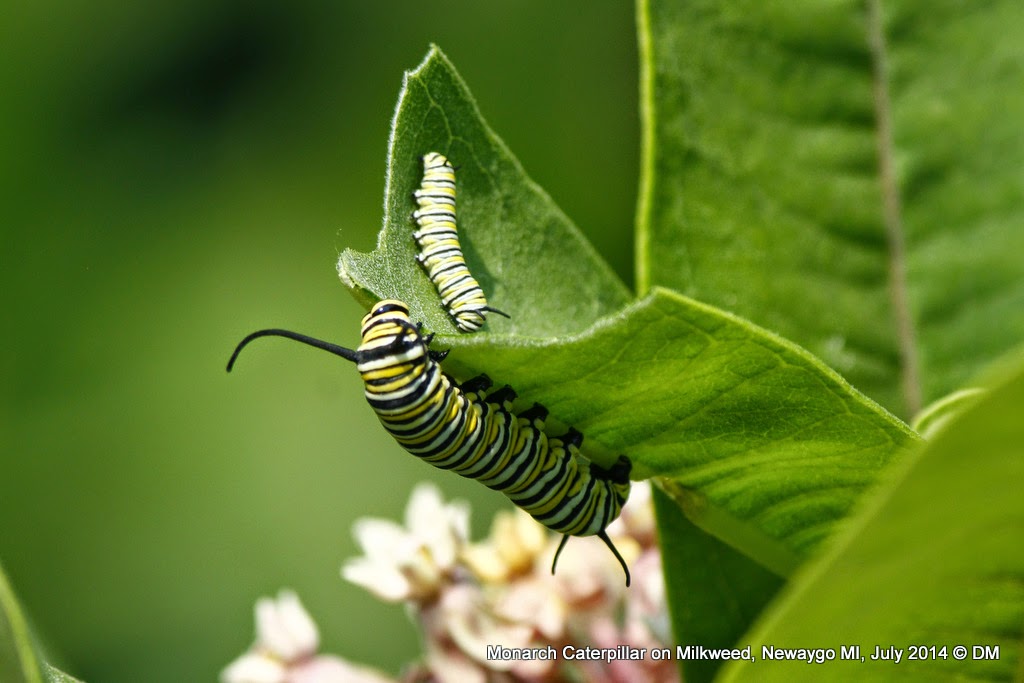
| Nom Nom Nom ...Monarch Caterpillars on its foodplant - Milkweed |
| Karner Blue Butterfly on Wild Lupine - Its larval foodplant |
I did not have much time to search for the Karner Blue butterfly so I stopped at one location that almost promised to host this endangered species: Michigan Nature Association's Karner Blue Sanctuary in Newaygo Michigan. Looking around, we saw many Monarch butterflies, some singles of American Copper and Grey Hairstreaks. I could have spent the afternoon at this sanctuary but almost upon finding my target species, my son declared that he had to go to the bathroom... So I tried my best to capture this rare butterfly with a brief 10 or so minutes of photography. This was the best I could do in my brief 10 minute stay... Oh the joys of parenthood! The Karner Blue Sanctuary was beautiful ... but sadly, it was being overrun with Spotted Knapweed, an invasive flower that chokes out native plants... such as Wild Lupine.
![]() |
| Karner Blue Butterfly - Dorsal & Ventral Composite |
Next stop was Greyling Michigan, which hosts the Kirtland's Warbler. A quick check of E-bird will give you some ideas of where to look. This bird was found pretty easily in a special forest of young Jack Pine trees with man made open areas.
| Kirtland's Warbler in Greyling MI |
| Vesper Sparrow |
| Brown headed Cowbird Traps |
| Oval shaped opening in Jack Pine Habitat |
![]() |
| Satellite view of Managed Kirtlands Forest Habitat along Fletcher Road. There were many oil derricks in the area (white patches on right) |
When visiting Greyling, or any part of Northern Michigan, I think a good afternoon activity is to Kayak a local river. In Greyling, they have a beautiful, clear, meandering river called the Au Sable River. My son and I rented a two-person sit-on-top kayak and kayaked for about 2 hours down this river. Surrounded by nature, with towering white pines and singing Pine Warblers, It was beautiful!
| Two hours on the Au Sable River in Greyling. Awesome. |
| White Pine along the Au Sable River |
We also visited Traverse City Michigan for a few days. One highlight of Traverse City is its proximity to Sleeping Bear Dunes. Sleeping Bear Dunes is one of the most beautiful beaches in North America and is a stonghold for the great lakes population of Piping Plovers. According to USFWS: "In 2008, there were 63 breeding pairs (126 individuals) in the Great Lakes region. Of these, 53 pairs nested in Michigan, while 10 were found outside the state, including six pairs in Wisconsin and four in Ontario, Canada. A single breeding pair discovered in 2007 in the Great Lakes region of Canada represented the first confirmed piping plover nest there in over 30 years, and in 2008 the number of nesting pairs further increased to four. In 2009, a pair of piping plovers nested on the Lake Michigan shoreline in Illinois, the first nest in Illinois in 30 years" (USFWS). I did attempt to visit one particular area where ebird had a sighting just days before my arrival (July 27th) but I was unable to find a piping plover at the Platt River Point area. A quick look at Ebird for Piping Plovers this year hinted that there were at least five sites in this park alone with breeding Piping Plovers.
| 450 ft dune!?!? |
![]() |
| Lake Michigan |
| No Piping Plovers at Platt Point in late July |
Just one last point - I couldn't help but notice beautiful pink flowers everywhere you look in northern michigan - the fields and roadsides all have this nice pink hue. Sadly, its Common Knapweed though, an invasive plant that chokes out native vegetation. Three ways that this plant is thriving:
- A tap root that sucks up water faster than the root systems of its neighbors
- Low palatability, meaning it is less likely to be chosen as food by herbivores
- It is also suspected to be allelopathic, releasing a toxin from its roots that stunts the growth of nearby plants of other species (Wikipedia)
![]() |
| Each Spotted Knapweed plant will produce over 900 seeds (gov.bc.ca) |
This plant was in the news at Point Pelee a few years ago, but now that I've seen how invasive and aggressive it is, I think its a good idea to get rid of this plant sooner then later.
To end this long posting, I had a great trip to Michigan and wanted to share some of the nature-based highlights of my trip. The northern half of the the lower peninsula of Michigan is so beautiful. Driving through the Manistee and Huron forests is breathtaking and its just hard to realize how much forest and wetland are still intact. Seeing the Karner Blue butterfly, even for a fleeting few minutes was one of the best nature discoveries of the year for me.
Good Birding!
Dwaynejava
Sources:
USWFS , "Piping Plover - Great Lakes Population", July 1, 2014
web, Aug 1 2014, http://www.fws.gov/midwest/EastLansing/te/pipl/index.html
More Reading:
ROM Karner Article
Karner Blue Sanctuary in Michigan
Karner Blue in Ohio
Spotted Knapweed
Friday, May 17, 2013
Kirtland's Warbler at Pelee
At noon on Wednesday May 15, 2013 I had checked my email at work to find an amazing Ontbird Posting. Barb Charlton & David 'The Machine' Bell found a Kirtlands Warber in the far northwest corner of the park, not too distant from the front entrance gate. I figured there was no way I was going to find it after working into the afternoon and driving to Leamington. But, to my amazement, it was still in the area it had been reported when I arrived at the park, easily seen foraging high in the single row of trees lining Sanctuary Pond. A large group of birders (and park staff directing traffic) made finding the bird simple. It was very high in the trees during my time viewing the bird, and I just got a few decent ID shots of this rare beauty. Hundreds of people got a chance to see this rare bird so Barb and Dave... Thank You!
Migration path and the chances of seeing this bird outside of Michigan:
Even though this bird migrates from the Bahamas Archipelago through Georgia and the Carolinas up through Ohio and finally ending in the northern lower peninsula Michigan, it is very rarely seen in migration. Magee Marsh and Point Pelee though have the advantage of being a popular migrant stop, being geographically small, and having huge numbers of talented birders scouring the place. To find this one bird in Point Pelee National Park though still takes more than luck, you have to be a brilliant birder.
A Brief History of the Kirtland's Warbler:
Discovery in 1851 - A specimen was shot and collected on Dr. Jared Kirtland’s farm near Cleveland, Ohio(US FWS). The birds name obviously honours its finder . Oddly enough, 1851 was the year John James Audubon died. It must have been amazing to discover a new bird that was never described!
Wintering Grounds Found in 1879 - The winter range of the Kirtland's warbler was discovered in 1879 when a specimen was collected on Andros Island in the Bahama Islands archipelago.(Michigan DNR)
Breeding Grounds found in 1903 - It was not until 1903 that Norman A. Wood discovered the first nest in Oscoda County in northern lower Michigan (Michigan DNR).
Jack Pine Habitat Requirements:
-Requires pine habitat with trees between 6-20 years old.
-Prescribed burns (or logging) has provided more optimal breeding habitat for the birds.
-Kirtlands Warblers prefer a nesting site with Blueberry bushes as that is a favored fruit of this bird... cool!
-Michigan and US Wildlife employees have done an amazing job helping this bird's population recover.
-A successful breeding nest was discovered at Petawawa Ontario in 2007 (Drake).
Cowbird Parasitism:
Besides it habitat requirements, Cowbirds had been hurting the breeding success rates, so a successful cowbird management program has been put in place to reduce the numbers and increase the nest success for the Kirtlands Warbler. Nature lover and blogger Kristen Martin features some photos of the cowbird traps here.
Improved Outlook for the Future:
This chart below shows a trend in the number of singing male Kirtlands Warblers in Michigan. Since 1990, a continual increase in the number of singing males is evident. Props to Michigan and the US-FWS for putting resources towards saving this wonderful species. I'm just a humble birder from Ontario, but perhaps Michigan should consider changing its state bird from the American Robin to the Kirtlands Warbler? :-)
| Image Source: Michigan DNR |
Other birds seen on May 15th were this Cape May Warbler (Setophaga tigrina)... I have not seen a northbound breeding-plumaged Cape May since May 1st, 2010 !!! Oddly, I have seen many southbound Cape May Warblers every year since.
| The Tiger-Warbler! (Setophaga tigrina) |
| How many Tern species do you see? Can you see the SB Dowitchers? |
![]() |
| Blenheim SL - Finally figured out where the gate is after 4 entrance attempts! |
I had missed a Worm-eating Warbler by a five minutes again after seeing the Kirtlands Warbler, but, I can't complain. My friend Rick from Leamington reminds me when I miss a rarity is that I need to "save something for retirement". So, Worm-eating Warbler... we have a date for late April 2030!!!
Good Birding!
Dwaynejava
Sources:
USFWS, "Kirtland's Warbler (Dendroica kirtlandii)",January 3, 2013 , WEB, May 16, 2013, http://www.fws.gov/midwest/endangered/birds/Kirtland/kiwafctsht.html
Michigan DNR, "Kirtland's Warbler (Dendroica kirtlandii)", ND, WEB, May 16, 2013
http://www.michigan.gov/dnr/0,1607,7-153-10370_12145_12202-32591--,00.html
Drake Laura, "Endangered warbler found nesting in Petawawa, Canada.com, NOVEMBER 2, 2007, WEB, May 16, 2013, "http://www.canada.com/story.html?id=a111ac43-2210-4785-a2b5-cd118a102e1f
Lifer Summary: Kirtlands Warbler -332
Subscribe to:
Posts (Atom)