Showing posts with label Dunlin. Show all posts

Sunday, October 18, 2015

Blenheim White-rumped Sandpipers & Some Vitamin N

White rumped Sandpiper at Blenheim

White rumped Sandpiper at Blenheim
Huge numbers of  White rumped Sandpipers have been showing up in Ontario during their southbound migration this year. Their main migratory path is through the central provinces and states. Ontario's blogosphere (See Mike Burrell's White Rumped Sandpiper Posting) and Ebird hinted unprecedented numbers --- flocks as 100-300 were seen throughout Ontario over the last month (sightings of 1-10 birds are normally expected). I wanted to witness this specticle over the last two or three weeks, but couldn't make it out to any good shorebird habitat till this weekend. I thought I had missed the boat - but a recent e-bird posting from just this past Wednesday hinted that many were still around, as many as 60 at Blenheim SL. So after work on Friday, I checked out Blenheim and was happy to see that there were still some good shorebirds to be seen. It was very windy and very cold. It almost felt like it was going to snow actually.

White rumped Sandpipers in flight - Their long primaries extend past their tails when at rest.

Birds seen include Willet, Greater & Lesser Yellowlegs, Pectoral, Dunlin, and of course --- White rumped Sandpipers. Several American Pipits were very present as well. Savannah Sparrows were seen as well as hundreds of Rudy Ducks and Northern Shovelers in the deeper ponds.

Blenheim Shorebirds - Labeled!

American Pipit


Img Src: https://www.allaboutbirds.org/guide/White-rumped_Sandpiper/lifehistory
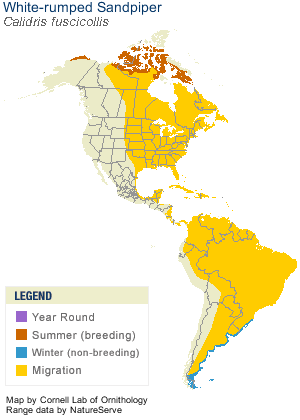
White rumped Sandpipers have one of the farthest migrations imaginable - They breed in Canada's Arctic and they fly all the way to the southern reaches of South America during the winter.  Some cool things that these birds might observe in the Arctic Circle is the Aurora Borealis - Northern Lights. They might also witness the "midnight sun" which the arctic circle experiences - Several months of daylight - uninterrupted by a sunset and night time due to the tilt of the earth's axis.  It seems cool to think about how they chase the sun --- they are always in a constant Spring-Summer-Fall-Migrate cycle.  They arrive late in the springtime - as late as June and migrate south a little later as well. Its amazing to think that these birds , weighing only 1.4–2.1 oz (allaboutbirds) make all this effort to avoid winter and to have access to food. Its just part of their nature. Amazing.


Img Src: http://www.astro.washington.edu/courses/astro270/On-LineLectures/astro101s03_whereonearth.html


Img Src: https://en.wikipedia.org/wiki/Aurora


The local Essex County Field Naturalists group forwarded this video about "Vitamin N" (N for nature). Its a 10 minute presentation from an MBA grad student about nature. Its pretty good, and if you are reading this page... I'm sure you would agree whole heartedly with his message. One of the nature scenes that he provides looks to be Nova Scotia's Cabot trail if I'm not mistaken.

Click here for the link to the video: http://www.slideshare.net/StanfordBusiness/unplug-recharge-how-spending-time-in-nature-can-change-your-life

This article in the Windsor Star was about students planting Dense Blazing star in a small tallgrass prairie behind St Clair College.
http://windsorstar.com/news/local-news/threatened-prairie-plant-gets-boost-at-st-clair-college


Good birding!
Dwayne

Yellowlegs

Friday, May 17, 2013

Kirtland's Warbler at Pelee


At noon on Wednesday May 15, 2013 I had checked my email at work to find an amazing Ontbird Posting. Barb Charlton & David 'The Machine' Bell found a Kirtlands Warber in the far northwest corner of the park, not too distant from the front entrance gate. I figured there was no way I was going to find it after working into the afternoon and driving to Leamington. But, to my amazement, it was still in the area it had been reported when I arrived at the park, easily seen foraging high in the single row of trees lining Sanctuary Pond. A large group of birders (and park staff directing traffic) made finding the bird simple. It was very high in the trees during my time viewing the bird, and I just got a few decent ID shots of this rare beauty. Hundreds of people got a chance to see this rare bird so Barb and Dave... Thank You!


Migration path and the chances of seeing this bird outside of Michigan:
Even though this bird migrates from the Bahamas Archipelago through Georgia and the Carolinas up through Ohio and finally ending in the northern lower peninsula Michigan, it is very rarely seen in migration. Magee Marsh and Point Pelee though have the advantage of being a popular migrant stop, being geographically small, and having huge numbers of talented birders scouring the place. To find this one bird in Point Pelee National Park though still takes more than luck, you have to be a brilliant birder.

A Brief History of the Kirtland's Warbler:

Discovery in 1851 - A specimen was shot and collected on Dr. Jared Kirtland’s farm near Cleveland, Ohio(US FWS). The birds name obviously honours its finder . Oddly enough, 1851 was the year John James Audubon died. It must have been amazing to discover a new bird that was never described!

Wintering Grounds Found in 1879 - The winter range of the Kirtland's warbler was discovered in 1879 when a specimen was collected on Andros Island in the Bahama Islands archipelago.(Michigan DNR)

Breeding Grounds found in 1903 - It was not until 1903 that Norman A. Wood discovered the first nest in Oscoda County in northern lower Michigan (Michigan DNR).

Jack Pine Habitat Requirements:
-Requires pine habitat with trees between 6-20 years old.
-Prescribed burns (or logging) has provided more optimal breeding habitat for the birds.
-Kirtlands Warblers prefer a nesting site with Blueberry bushes as that is a favored fruit of this bird... cool!
-Michigan and US Wildlife employees have done an amazing job helping this bird's population recover.
-A successful breeding nest was discovered at Petawawa Ontario in 2007 (Drake).

Cowbird Parasitism:
Besides it habitat requirements, Cowbirds had been hurting the breeding success rates, so a successful cowbird management program has been put in place to reduce the numbers and increase the nest success for the Kirtlands Warbler. Nature lover and blogger Kristen Martin features some photos of the cowbird traps here.

Improved Outlook for the Future:
This chart below shows a trend in the number of singing male Kirtlands Warblers in Michigan. Since 1990, a continual increase in the number of singing males is evident. Props to Michigan and the US-FWS for putting resources towards saving this wonderful species. I'm just a humble birder from Ontario, but perhaps Michigan should consider changing its state bird from the American Robin to the Kirtlands Warbler? :-)

Image Source: Michigan DNR

Other birds seen on May 15th were this Cape May Warbler (Setophaga tigrina)... I have not seen a northbound breeding-plumaged Cape May since May 1st, 2010 !!! Oddly, I have seen many southbound Cape May Warblers every year since.
The Tiger-Warbler! (Setophaga tigrina)


How many Tern species do you see? Can you see the SB Dowitchers?
Blenheim SL - Finally figured out where the gate is after 4 entrance attempts!

I had missed a Worm-eating Warbler by a five minutes again after seeing the Kirtlands Warbler, but, I can't complain. My friend Rick from Leamington reminds me when I miss a rarity is that I need to "save something for retirement". So, Worm-eating Warbler... we have a date for late April 2030!!!

Good Birding!
Dwaynejava

Sources:

USFWS, "Kirtland's Warbler (Dendroica kirtlandii)",January 3, 2013 , WEB, May 16, 2013, http://www.fws.gov/midwest/endangered/birds/Kirtland/kiwafctsht.html

Michigan DNR, "Kirtland's Warbler (Dendroica kirtlandii)", ND, WEB, May 16, 2013
http://www.michigan.gov/dnr/0,1607,7-153-10370_12145_12202-32591--,00.html

Drake Laura, "Endangered warbler found nesting in Petawawa, Canada.com, NOVEMBER 2, 2007, WEB, May 16, 2013, "http://www.canada.com/story.html?id=a111ac43-2210-4785-a2b5-cd118a102e1f

Lifer Summary: Kirtlands Warbler  -332

Friday, April 19, 2013

Blue Grosbeak at Ojibway!


This afternoon I birded Hillman Marsh and had the intention of birding a few paths at Point Pelee to try my luck with some mid April migrants. Hillman was really good... I had seen tons of duck species, Dunlin, Yellowlegs, Horned Grebe (directly under the Hillman Bridge), as well as some seasonal passerines including Blue-grey Gnatcatcher. Upon entering the front gate at Point Pelee, I figured I would check my email on my phone, so see if any good (local) Ont-bird postings were reported for this afteroon. Of course, the Blue Grosbeak posting came up, but I was still wanting to walk the Woodland Nature Trail at Pelee. The trail was good, my best bird was a Blue headed Vireo (see below). But, I couldn't help but want to rush out of Pelee to see the Blue Grosbeak at Ojibway Park.

Upon arival to Ojibway, lots of familiar birders were around. Jeremy Bensette pointed out the bird to me and I was able to get great looks at it, both from outside and inside the visitor center. (the second photo above is from inside the visitor center). Tom Preney found the Grosbeak this morning, and I can't even imagine how exciting that would have been to see this bird. That deep blue colour along with its chestnut coloured wingbars was awesome to see.... an exciting lifer!

Wow... Love this bird!


Full-frame shot of a Horned Grebe, just meters from the Hillman Marsh Bridge.


 Ojibway park has been great this week, ... First of Season Eastern Towhees easily seen along with many other great birds such as Eastern Bluebirds, Fox Sparrows, both Kinglets and this Yellow bellied Sapsucker. A belted Kingfisher was on site at Malden, and Jeremey had even seen a Green Heron there as well.
E-birding fans will be happy to know that I'm reporting more. It feels good to contibute to e-bird rather than just be a viewer of its statistical data. Got to cut it short here!

Good birding!
Dwaynejava

Blue Grosbeak (#329)


Friday, April 6, 2012

Birding Hiatus Birding


Having a little time to spare this morning, I figured I would try my luck at finding the Black Scoters that were so abundantly* reported as of late at Point Pelee. On the way to PPNP, I stopped by Hillman Marsh  and checked out the shorebird cell & wetland cells. Upon arrival at the shorebird cell, Kelly and Sylvain greeted me and gave a run-down at what was being seen (no Common Teal). Kelly mentioned a Northern Bobwhite calling about 20m to the right and mentioned how they were common back in her home state. She attempted to whistle the call but curiosity forced me to play the call on my Ibird App. A few moments later, the Bobwhite called with its very distinct and obvious call, fresh in my memory from having just played it. Northern Bobwhite was lifered about a year ago in Florida at the Cecil B. Webb WMA near Fort Myers. One crossed the road while I was driving... but its one of the few birds on my life list that I never got a photo of. 

The wetland cell was pretty quiet but had two Yellowlegs and about 20 Dunlin.

At Pelee, the tip's west beach was today's main destination.  While waiting for the tram to the tip, I re-united with Kelly and Sylvain along with Kory who had an incredible new 85mm Vortex scope. The four of us scanned the rafts of ducks from the tip parking lot, looking for Black Scoters.  Amongst thousands of Scaup,  (I think) I saw a Common Loon along with smatterings of Rudy Ducks, Bufflehead, and Surf Scoter. After walking North from the West Beach tip parking lot, we had a great vantage point on thousands of Ducks and Kory spotted the Black Scoter after considerable effort. Kory then spotted a pair of Horned Grebes that were right in front of us!
Where's Waldo? Where is Black Scoter?

*About four Black Scoter were amongst thousands other ducks. I can't beleive how hard it was to find them. A good scope, a little luck and patience were needed to see this rare coastal and salt water dwelling scoter!

A quick walk along Shuster Trail turned up several Winter Wrens, a Hermit Thrush and a few sparrows. A small Kinglet was seen next to the visitor center. I left the park at about noon as I had church and family plans.  Overall, it was a 'Good Friday'.

Good birding!
Dwaynejava

PS: Check out this photo that Raymond Barlow took of a Peregrine Falcon at Niagara Falls...
 
PSS: Did you hear that there is a Cougar roaming around in Amherstburg right now?

Lifer Summary:
Black Scoter - 296

Monday, October 10, 2011

Better looks at Hudsonian Godwits and Other Shorebirds in Comber


Wow... after talking to Blake Mann and Ellen Smout over the weekend, it was suggested that the best viewing was in later afternoon, as the sun setting in the west would give nice front-lit views of some incredible shorebirds. So at about 5pm today, I politely excused myself from Thanksgiving festivities and headed out to Comber for a quick 30-minute birding session. Glad I did... check out some of the pics below.


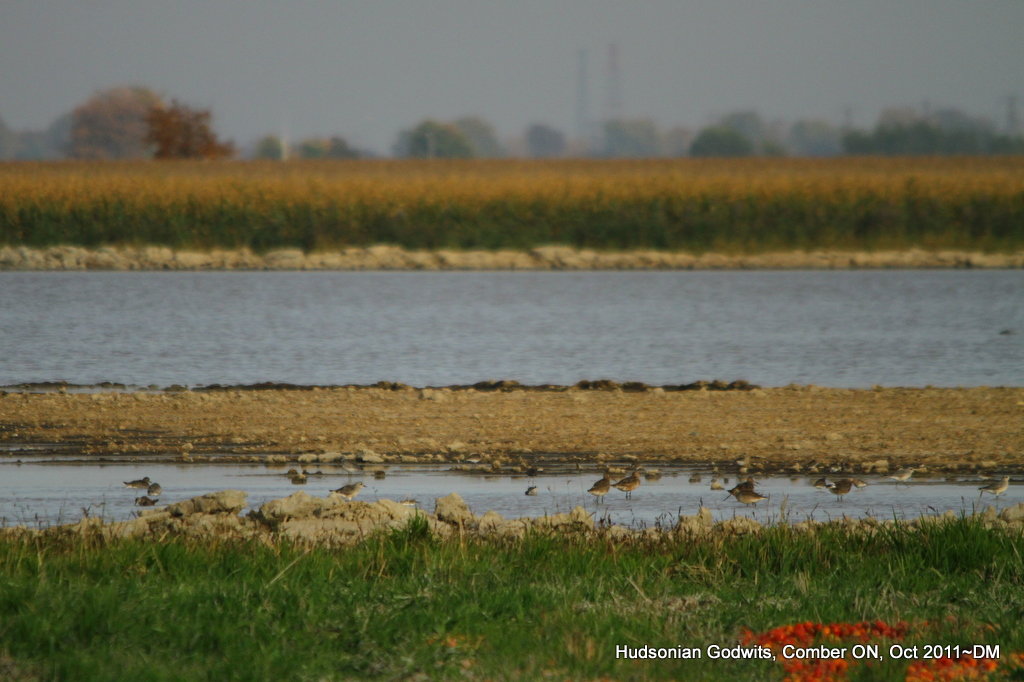
A Hudsonian Godwit flies above 20 resting shorebirds in this tightly cropped photo. Incredible.

Juv. White rumped Sandpiper (I think...)
from yesterday... Golden Plovers
Dunlin and White Rumped Sandpipers

Mix of shorebirds on the east end of the tomato field
Thanks to Ellen Smout for sharing this great find. I lifered three birds this weekend!

Good birding!
Dwaynejava

Bonus! 20 Seconds of video of Hudsonian Godwits preening and sleeping.


Lifer Summary:

American Golden Plover #284
Hudsonian Godwit #285
White rumped Sandpiper #286

Friday, April 8, 2011

Point Pelee Birding in Early April


I got out of work early today, so I figured I would go to Point Pelee and see whats happening bird-wise. In short: Yellow bellied Sapsucker, Northern Flicker, Eastern Phoebe & Brown Creeper were abundant!

My first stop was  ERCA's Hillman Marsh. When I arrived at mid-afternoon the weather was pretty cold, windy and not very good for birding. I noticed the wetland cell had 10+ Great Blue Herons, as well as many common seasonal ducks.

The shorebird cell had thousands of Canada Geese. A few Tree Swallows were flying around. A Greater Yellowlegs was found as well as about 15 Dunlin (let me know if I've mis-identified these shorebirds).

 Dunlin?
The onion fields. The soil is so rich, so black. You almost want to get out of your car and pick up some soil in your hands. There is an interesting historical connection with these fields and the natural history of the area. I would like to learn more about it. My understanding is that Point Pelee's marsh extended to Hillman marsh but was dyked and drained to create fertile farming fields. I've seen similar onion fields bordering St Clair NWA and Rondeau (at Erieau).

At Point Pelee, I first walked Shuster Trail. I heard Winter Wrens and saw BCCs as well as a few Cardinals. After Shuster Trail, I walked Tildens Trail. Birds seen include: Golden crowned Kinglets (4), Brown Creepers(4), and Yellow Bellied Sapsuckers (6) were pretty easily seen. I heard an Eastern Towhee but was unable to find it.
 
 Habitat for prothonotary Warblers. Lets hope they hang out a little this spring. Last Spring they did not stay very long at Point Pelee or Rondeau.

Later I walked Woodland Nature Trail and saw more of the same birds. Several more Yellow bellied Sapsuckers (6), Golden Crowned Kinglets (3), Brown Creepers(4) as well as a plethora of blackbirds and Robins. I did not see a Hermit Thrush today. I did not see any early Warblers today either, although I was not really looking for them.

Yet another YBSS. I saw many but did not get great photos of them.

The trail on the west beach side of the tip had many Flickers (4) and Wild Turkey (5). There was a male Turkey showing off his feathers to impress the ladies. Many Eastern Phoebes were around... really they were almost everywhere. I also saw Red breasted Mergansers were seen off west beach.

Some misses today were Hermit Thrushes, Scoters, Common Loons and Grebes. I wonder what this weekends warm front will bring in?

Good birding!
Dwaynejava

PS: I met the park interpreter Sara today after my walk and she informed me that they new marsh boardwalk will be ready around mid-April (next week). I hope to find some marsh birds in mid to late April.


Some Good Reading

The Essex County Field Naturalists put together a great publication, and the most recent one includes an Annual Point Pelee Bird Report for 2010.
http://www.ojibway.ca/egret-03-11.pdf (See page 32 for a reference to yours truly)


Point Pelee's May Calendar (right-click, open in New Window)
http://www.pc.gc.ca/eng/pn-np/on/pelee/ne/ne5/~/media/pn-np/on/Pelee/pdf/FoB_Calendar2011_en.ashx

Did you know Point Pelee and Ojibway Park are on twitter?

http://twitter.com/#!/PointPeleeNP
http://twitter.com/#!/OjibwayPark

LinkWithin

Related Posts Plugin for WordPress, Blogger...