Wednesday, June 4, 2014

Early June Butterfly Watching in Windsor

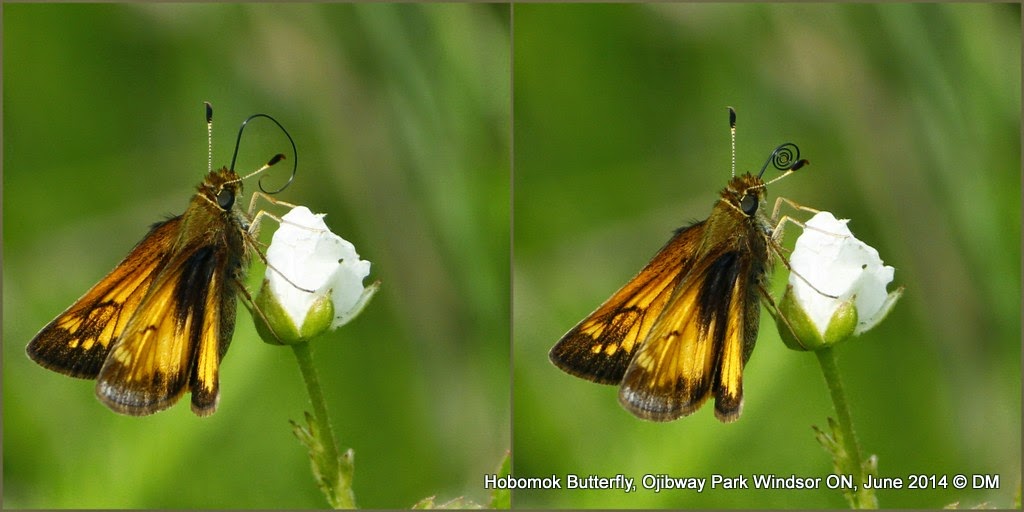
Ventral view of a fresh female Hobomok Skipper as it taps into a wildflower

I've attempted to view and photograph some butterflies this week and just figured I would share some of my sightings. I find I'm still learning so much with regards to identification! While I was photographing these butterflies, I heard Song Sparrows, Field Sparrow, Indigo Buntings and Great crested Flycatchers singing from the surrounding trees!

This week, I've seen:
Black Swallowtail
Spicebush Swallowtail
Giant Swallowtail

Hobomok Skippers
Tawny-edged Skippers
Peck's Skippers
Viceroy
Eastern Tailed Blue
Juvenals Duskywing
Duskywing Species
Pearl Cresent
Common wood Nymphs
Cabbage White
Orange/Clouded Sulphur

Black Swallowtail - Note the tiny black "dot" at the very bottom of its wings

Peck's Skipper Nectaring on Red Clover
Dorsal views of a female Hobomok Skipper butterfly - Note how it proceeds to coil its probiscis before taking flight!

Tawny edged and Crossline skippers are similar, but Tawny are smaller and are more common in June. This collage features both a ventral and dorsal view of a Tawny edged Skipper.
I've realized that there is now an e-bird equivalent for butterfly watchers! Its called E-Butterfly and if I'm not mistaken, its based in Ottawa Ontario! I created an account recently but I just don't know if I have time to really log my sightings. 

Good butterfly watching!
Dwaynejava

PS: My birding friends recently participated in a Ballie Birdathon which raises money for Bird Studies Canada. I don't know if I can motivate any of my blog readers to donate but if you are so inclined, please click the link here for the "No rEgrets" team. Kory Renaud, Jeremy Bensette, and Jeremy Hatt have raised over $1000, and I just donated $40 myself.  I read recently that North Americans spend $2 Billion per year on Halloween Candy... Imagine people donated just a fraction of the money they spend on Halloween candy to conservation and research? 

Sunday, June 1, 2014

Bicknell's Thrush at Point Pelee v2

Black Vulture easily seen above Pelee on Saturday. Note the white primaries on the Black Vulture


This weekend, I had planned on going to Carden Alvar for a day of amazing birding. But on Friday night, before I was about to leave, my son looked at me with his big brown eyes and said "Daddy, will you take me to Paint Peldy toomordo (spelling was intential for effect)?"  ... How could I say no?

So Saturday morning, on the way to Pelee, my friend Rick texted me to tell me a Bicknell's Thrush had been found by Alan Wormington near the tip of Pelee.

As the Tram arrived at the visitor center, Todd Pepper pointed out a Black Vulture in a kettle of Turkey Vultures. I believe that was also found earlier by Alan Wormington as well!


Upon arriving at the tip, the bird was found quickly along west beach because Jeremy Hatt and Jeremy Bensette were with the bird.  The photo above represents my best look at the bird, which sat there for about 45 seconds, then it flew away.

Was my May 20th Blog Posting a Premonition?
On May 20th, blog readers may recall I commented on the excellent variety of Thrushes at Point Pelee. I had noted that pretty well 6/7 of the Eastern breeding Thrushes, save for Bicknells was in the park:

"Some nice Thrush species were seen as well. On Saturday, Veery, Swainson's Thrush, Robins, Wood Thrush, Gray cheeked Thrush were all seen. In fact, I think all the Eastern Thrush Species were in the park with the exception of Bicknells! Along the Tilden Woods Footpath, I heard my first singing Wood Thrush for the season."

Jeremy Bensette mentioned to me that this is the first sighting for Point Pelee, bringing the park's total very close to 400 species... So this is a MEGA rarity for both Point Pelee and perhaps Ontario!

Bicknell's Field Study
I did not see this bird long enough, nor am I an experienced enough birder to really confidently give a good study of the field marks that identify this bird. It seems that the closest two species of birds to a Bicknells Thrush would be a Gray cheeked Thrush and perhaps a Hermit Thrush. Both of these birds may have several subspecies that make this identification a very tricky ID.  Even David Sibley states: "Voice (and primarily song) is still the most reliable way to distinguish these species. In areas where they are expected, it may be reasonable to identify small and reddish birds as Bicknell’s Thrush after careful and lengthy study, even without hearing them sing, but I don’t think sight observations or photos alone would ever be acceptable evidence of a bird out of range, for example, in Ohio, or Alaska, or the UK." (Sibley).  But, I think if anyone in the province of Ontario is qualified to ID an eastern thrush - which was well off its migratory route (Bicknell's Thrush breeds in Quebec, NB and the Maritime Provinces), its Alan Wormington. It afforded great looks at close range to its finders, but sadly when I arrived, there were so many people walking around on Saturday morning, it was skulking in the shrubs along with tip's west side path. If anyone wants to comment on the field marks... please feel free to do so!

Also, at one point, Jeremy Hatt, Jeremy Bensette were looking at the bird while I was taking this photo and the bird deficated. Jeremy Hatt joked that if we had a ziplock bag, that the excriment could be sent away, perhaps for DNA analysis! As chance would have it, I had put my son's sunscreen and bug-spray into a spankin new ziplock bag that morning and it was in my backpack holder! I'm not saying to collected the sample but it wasn't me! I will keep you informed on any results that that test may deliver!

Bicknell's Thrush - Diagnostic Photo?


Lots of Cedar Waxwings at Point Pelee on Saturday affording nice views!!!

Good Birding!
Dwaynejava


Sources:
Sibley David ,  Bicknell’s Thrush Catharus bicknelli, November 18th, 2010, WEB June 1, 2014,
http://www.sibleyguides.com/bird-info/bicknells-thrush/

Life list Summary
346 - Pacific Loon
347- Bicknell's Thrush


PS: If I go to Carden Alvar soon, I could get three potential species bringing me to 350!
Whip-Poor-Will, Sedge Wren and Golden Winged Warbler!

Yellow headed Blackbirds at Mitchell's Bay

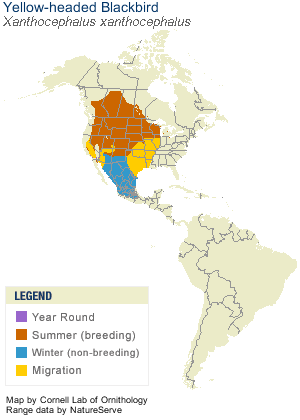
 Yellow Headed Blackbird - Xanthocephalus xanthocephalus
Its been well known and documented that Yellow headed Blackbirds have been breeding in Southwestern Ontario this spring at a Lake St Clair wetland near Mitchell's Bay.  I have been wanting to go out and see them and this past weekend May 24th),  I was able to finally get out and see them. It was nice to find them so easily along the road. Bright yellow heads, bold white wing patches visible in flight. Amazing birds! I did not stay long to see them (just 5-10minutes) but I must say, it took a moment for them to vocalize and when they did... wow. What a crazy song! It is described a loud rusty farm gate closing!

In my short 4-5 years of birding, I've only seen this bird once at Pointe Mouillee in Michigan, so its not a life bird, although, its my first Canadian look at them and my first photo and blog reference to them. Check out the range map from AllAboutBirds.org below. The E-bird range map for this bird (set for this year only) hints that this year, it is increasingly present on the eastern half of the continent.

Image Source: http://www.allaboutbirds.org/guide/yellow-headed_blackbird/id
Allen Woodliffe [Link], Blake Mann [link], and Josh Vandermeulen [link] all have excellent postings and photos on these birds. Check them out! Jean Iron also took some excellent video footage where you hear the incredibly unique call of these birds [click here for Jean's Yellow headed Blackbird footage] .


Family Rondeau Park Visit (Sunday May 25th)
I took the family out for some nature hiking at Rondeau this past Sunday. We walked Spicebush trail first. Some birds seen include:
Red-eyed Vireos
Red breasted Grosbeak
Thrush
Canada Warbler (its been a good year for me seeing this bird!)
American Redstart
Yellow Warbler

Tulip Tree Trail
Starting at the Beach, I had noted:
Eastern Bluebird,
Baltimore Oriole,
Spotted Sandpiper
(no whimbrels)
Wilson's Warbler
Bay breasted Warbler
Wood thrush
Acadian Flycatcher (90% sure - didn't hear it calling but did note quick, darty flight, eye-rings, mid-forest)
Eastern Wood Peewee
Yellow Warbler
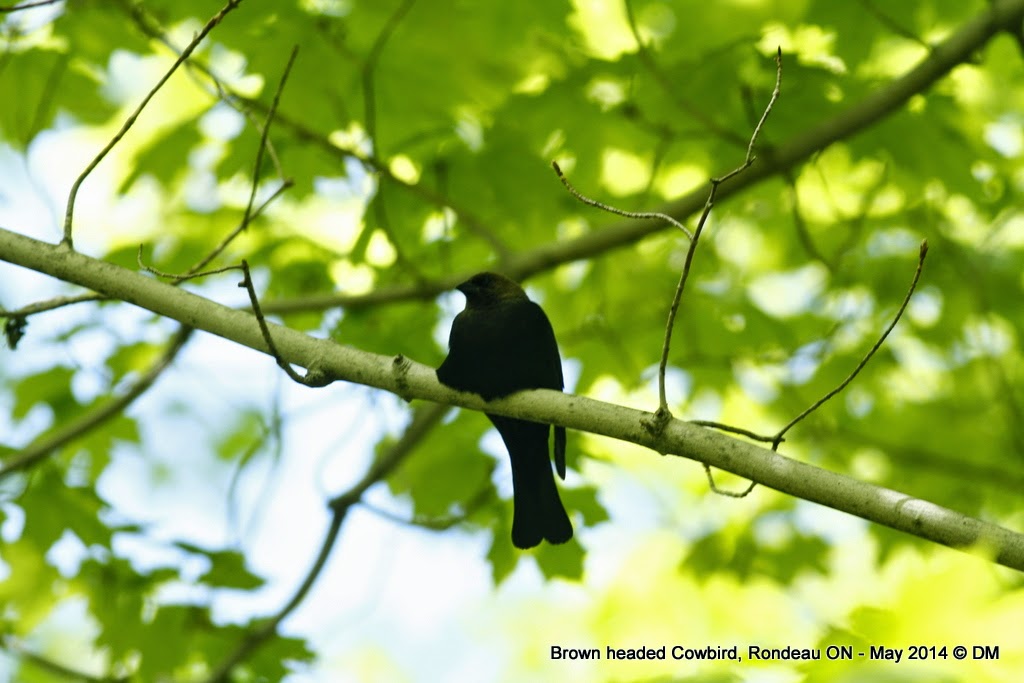
Brown headed Cowbird (mid-forest???)
Scarlet Tanager
Prothontary Warblers (male and female)


Acadian Flycatcher? 90% sure!


Female Prothontary Warbler at Rondeau - Note the white undertail coverts

I was amazed as I drove around Rondeau how many Brown-headed Cowbirds were perched roadside and in and along the forest pathways. I'm not a biologist, but I wonder if culling these birds will ever be considered? Especially considering how much some of our rarer breeding species are declining. They had great results with a program in Michigan's Huron-Manistee forest where the Kirtlands Warbler breeds.

Good birding!
Dwaynejava

Tuesday, May 20, 2014

May 17-18 Birding: Pelee, Kopegaron Woods, and Oak Openings Metropark


Kopagaron Woods last Friday was pretty amazing. I had attempted to twitch a Scissor tailed Flycatcher in Wheatley, and figured I would stop by Kopagaron Woods. It was pretty amazing. There was a small group of warblers and migrants which were staying very low due to the cold temps that had moved in late last week. Right near the entrance to the forest path was amazing. Northern Waterthrush, Ovenbird, Canada Warbler were present with many Bay breasted Warblers, Chestnut sided, Magnolia, Indigo Bunting, Scarlet Tanagers all very close to the ground! Veery and Swainson's Thrushes were very present as well.


Female Blackpoll Warbler
The following day, I spend the morning at Point Pelee and upon arrival, I was able to see a Pacific Loon that Jean Iron had ontbirded just as I arrived at the park. She had it in her scope as I reached east beach! More Philadelphia Vireos were seen along east beach.  Some nice highlights as the afternoon progressed were: Northern Parulas at close range, Canada Warblers, Yellow breasted Chat and Ruby throated Hummingbird nectaring Wild Columbine Flowers!


Northern Parula right along Tilden's Woods footpath

Yellow breasted Chat - Perhaps on breeding territory? Lets hope! This guy was singing from a thicket making all kinds of weird noises... Trying to impress the ladies!

Hummingbird nectaring on Wild Columbine flowers

Some nice Thrush species were seen as well. On Saturday, Veery, Swainson's Thrush, Robins, Wood Thrush, Gray cheeked Thrush were all seen. In fact, I think all the Eastern Thrush Species were in the park with the exception of Bicknells! Along the Tilden Woods Footpath, I heard my first singing Wood Thrush for the season. It's song was amazing to hear. If you have a few minutes, and want an amazing read and description of the wood thrush, click here to read John James Audobon's account of this bird. You owe it to yourself!


Sunday, my family visited Toledo Zoo, but stopped by Oak Openings Metropark for a quick 20 minute walk. I hate rushed birding, but in that twenty minutes, I had seen:
Summer Tanager
Scarlet Tanager
Indigo Bunting
Eastern Bluebird
Lark Sparrow
Red headed Woodpecker - (seamingly lots - 4 seen along a 50m walk)
Eastern Kingbirds


Oak Openings is the Easternmost Stronghold for this beautiful western sparrow


I stopped by a small area withing the Oak Openings to look for the re-introduced Karner Blue butterfly. I spoke to a few women in the parking lot who informed me that the re-introduced Karner Blue is basically not "thriving" as their website suggests and that there is only one area which they might still be seen at, but it is off bounds to public, and hasn't been seen yet this year. Along the parking lot, Eastern tailed Blues and Dreamy Duskywings were visible along with Tufted Titmouse at close range.

Good birding!
Dwaynejava
Wild Lupine - Easily Seen at Oak Openings and the foodplant for the extirpated Karner Blue butterfly

LinkWithin

Related Posts Plugin for WordPress, Blogger...